Summer Electric Reserve Margins Look OK, NERC Says
David Wagman | June 05, 2017The North American Electric Reliability Corp. 2017 Summer Reliability Assessment finds enough resources exist to meet this summer's projected peak electricity demand.
Anticipated reserve margins, the amount of expected unused electric generating capacity at the time of peak load, range from slightly less than 15% in New England to almost 29% in New York.
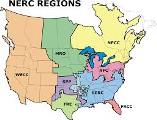 NERC is a nonprofit corporation that oversees regional electric reliability entities in the lower 48 United States, Canada, and parts of Mexico.
One metric of electric reliability is the anticipated reserve margin, measured as the percentage by which expected generating capacity exceeds net internal demand. Net internal demand reflects the total internal demand minus demand-response systems that are expected to be available during a peak demand hour.
A reserve margin of 15% means that about 15% of a region’s electric generating capacity would be available as a buffer to meet the summer’s peak hourly load in case of unforeseen generation or transmission outages.
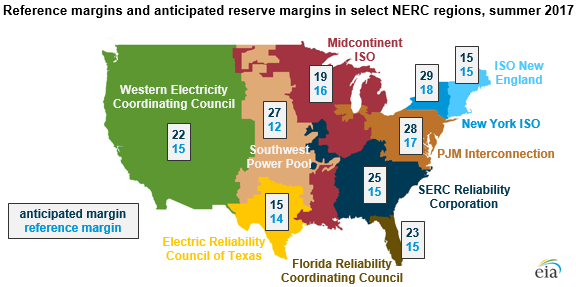 Reserve margins by regionReference margins differ by region and are reserve margin targets based on each area's load, generation capacity, and transmission characteristics. In some cases, the reference margin level is a requirement implemented by states, provinces, independent system operators, or other regulatory bodies. Reliability entities in each region aim to have their anticipated reserve margins surpass their reference margins, which are generally set near 15% in most regions.
The Energy Department's Energy Information Administration (EIA) says the anticipated reserve margins for all U.S. regions in NERC’s assessment are higher than their reference margins this summer, except for the Independent System Operator for New England (ISO-NE). In ISO-NE, the anticipated reserve margin is 14.9%, lower than the reference margin of 15.1%.
ISO-NE has 29,984 megawatts (MW) of anticipated resources this summer, which includes certain existing capacity and net firm capacity transfers from other areas. Another 315 MW of prospective resources are expected to become available this summer but are not included in the calculation of anticipated resources. Including these resources brings ISO-NE’s prospective reserve margin to 16.1%.
Anticipated reserve margins are highest in the New York Independent System Operator (NYISO) and PJM Interconnection, where reserve margins exceed 28%. Reserve margins that are significantly higher than target levels indicate the region may have excess underused or unused generation capacity, EIA says.