How it Works: Crushers, Grinding Mills and Pulverizers
Ken Thayer | June 02, 2017Crushers, grinding mills and pulverizers are types of grinding equipment used to transform or reduce a coarse material such as stone, coal, or slag into a smaller, finer material. Grinding equipment can be classified into to two basic types, crushers and grinders. Industrial crushers are the first level of size reducer; further granularization occurs in grinding mills or pulverizers.
 Rock crusher
Material is reduced by crushers and grinders by fracturing, which takes place when the material is put under stress by the moving parts of the crushing or grinding equipment. Forces applied during the process may be compressive, shear or impact. The material fractures when the internal strain levels reach a critical level. Energy is released when the material fractures, primarily as heat.
Several theories for the science of size reduction have been developed, including Rittinger’s Law, Kick’s Law, and Bond’s Law.
Rittinger’s Law states that the energy required in size reduction is proportional to the new surface created by the particle fragmentation. The equation for Rittinger’s Law can be written as:
E = KRfc(1/L2– 1/L1)
Where: E=Energy, KR=Rittinger’s Constant, fc=crushing strength of the material, L1=initial length, and L2=reduced length.
Kick’s Law states that the energy is proportional to the size reduction ratio. The equation for Kick’s Law can be written as:
E = KKfc loge(L1/L2)
Where: E=Energy, KK=Kick’s Constant, fc=crushing strength of the material, L1=initial length, and L2=reduced length.
Bond’s Law states that the total work input represented by a given weight of crushed product is inversely proportional to the square root of the diameter of the product particles. Bond’s Law can be written as:
E = Ei (100/L2)1/2[1 - (1/q1/2)]
Where: E=Energy, L1= initial length, L2=reduced length, Ei is defined as the amount of energy required to reduce a material’s unit mass from an infinitely large particle size to a size of 100 μm and L is measured in microns and q is the reduction ration L1/L2.
For more on Kick and Rittinger’s Law, see “Rock Crushing Theory and Formula using Kick & Rittinger’s Law” on 911 Metallurgist.
Crushers
Industrial crushers reduce large rocks, ore or waste materials to smaller sizes by impact or pressure to fracture or deform the material. During the primary crushing operation, boulder size feeds from 20 to 100 in. are reduced to secondary crusher sizes of 1 to 20 in. or mill feed size of .5 to 3 in.
Many different types of crushers exist with varying designs and crusher processes. The proper choice is dependent on several factors, including the hardness of the material to be crushed, the abrasive properties of the material, the moisture content and the reduction ratio required. The following table lists various crusher types and their general specifications and uses.
|
Type |
Hardness |
Abrasion Limit |
Moisture Content |
Reduction Ratio |
Main Application |
| Jaw crushers | Soft to very hard | No limit | Dry to slightly wet, not sticky | 3/1 to 5/1 | Heavy mining, quarried materials, sand & gravel, recycling |
| Gyratory crushers | Soft to very hard | Abrasive | Dry to slightly wet, not sticky | 4/1 to 7/1 | Heavy mining, quarried materials |
| Cone crushers | Medium hard to very hard | Abrasive | Dry or wet, not sticky | 3/1 to 5/1 | Quarried materials, sand & gravel |
| Compound crusher | Medium hard to very hard | Abrasive | Dry or wet, not sticky | 3/1 to 5/1 | Mine, building materials |
| Horizontal shaft impactors | Soft to medium hard | Slightly abrasive | Dry or wet, not sticky | 10/1 to 25/1 | Quarried materials, sand & gravel, recycling |
| Vertical shaft impactors (shoe and anvil) | Medium hard to very hard | Slightly abrasive | Dry or wet, not sticky | 6/1 to 8/1 | Sand & gravel, recycling |
| Vertical shaft impactors (autogenous) | Soft to very hard | No limit | Dry or wet, not sticky | 2/1 to 5/1 | Quarried materials, sand & gravel |
| Mineral sizers | Hard to soft | Abrasive | Dry or wet and sticky | 2/1 to 5/1 | Heavy mining |
| Crusher buckets | Soft to very hard | No limit | Dry or wet and sticky | 3/1 to 5/1 | Heavy mining, quarried materials, sand & gravel, recycling |
Table Source: Wikipedia (Crushers)
Cone crushers use a spinning cone that gyrates in the bowl in an eccentric motion to crush the rock between the cone surface, referred to as the mantle, and the crusher bowl liner. Gyratory crushers are very similar to cone crushers, but have a steeper cone slope and a concave bowl surface. As the gap between the bowl liner and the mantle narrows, the rock is crushed between the mantle by the gyrating cone.
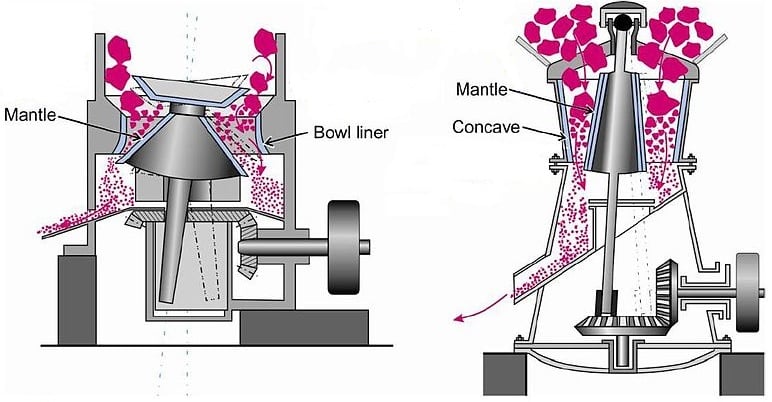 Cone crusher (left) and gyratory crusher (right)
Horizontal shaft impactors (HSI) have a horizontal shaft that turns a heavy duty rotor. Bars attached to the rotor fling the material to be crushed against an impact apron (or curtain) that contains replaceable liners. The impact, using the principal of surface force, breaks the material, reducing it
to a size 1/10 to 1/25 of the original.
 VSI crusher
Vertical shaft impactors (VSI) have a vertical shaft and enclosed rotor that turn at high speeds. There are two main types of VSI crushers, rock-on-rock (autogenous) and shoe and anvil. Rock-on-rock crushers have pockets filled with rock lining the entire circumference of the chamber. Shoe and anvil VSI crushers have composite metal alloy anvils positioned to maximize the impact of the material that is thrown against the stationary anvils via centrifugal force. Comparisons with cone crushers have shown VSI crushers to be more energy efficient and also to produce more fine material under the same operating conditions and time frame.
Jaw crushers use mechanical pressure to break the material by forcing it between two vertical jaws, one stationary and one that is driven back and forth. The gap between the two jaws narrows as the material moves through the crusher, further reducing the size. Jaw crushers are heavy duty machines and can be used in mining or quarry applications for very hard materials.
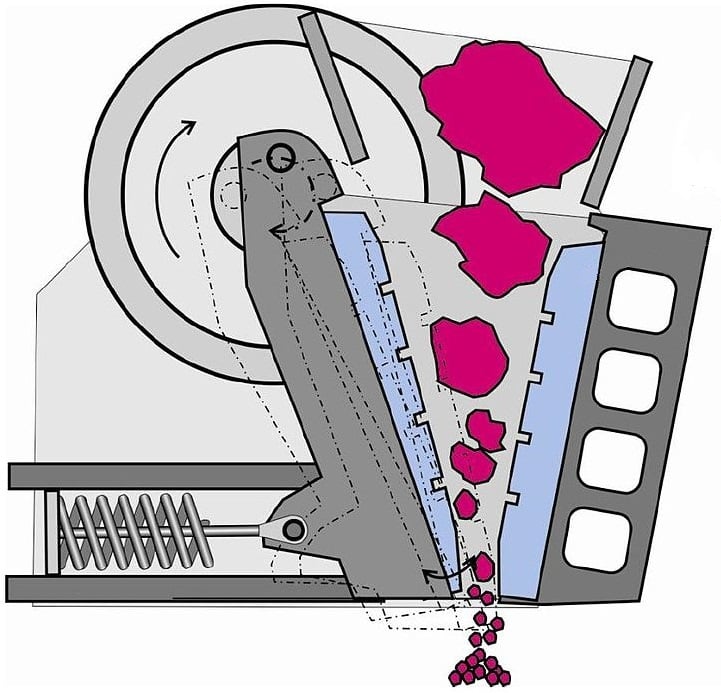 Jaw crusher
Mineral sizers are one of the newer technologies to the crushing industry. They feature two rotors, each fixed with large teeth that rotate in opposite directions at low speeds. The material to be crushed is fed onto the rotors and is gripped and then crushed between the teeth. When sufficiently reduced, the crushed material falls between the rotors and exits from the bottom of the crusher.
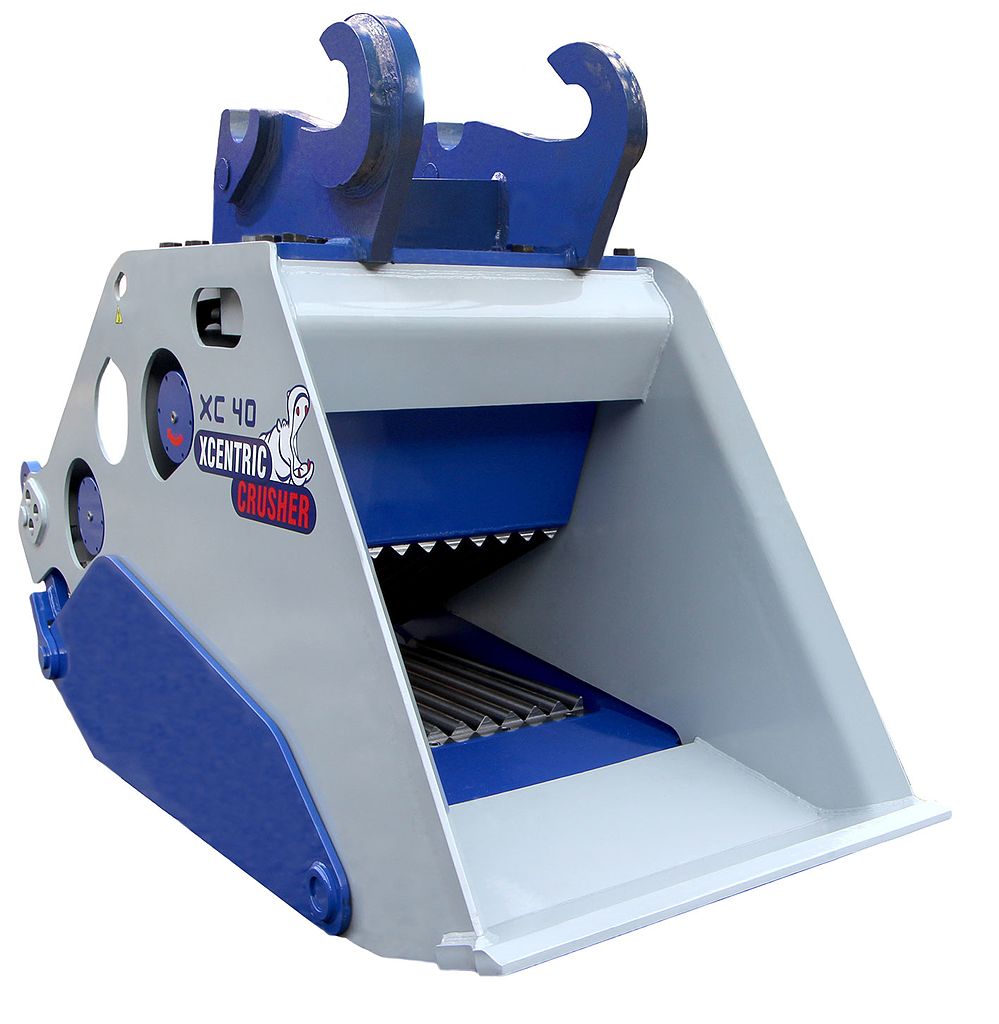 Crusher bucket (Image credit: MB S.p.A.)
Crusher buckets are excavator attachments that contain two jaws, one fixed and one that moves back and forth, much like a jaw crusher.
Grinding Mills and Pulverizers
Grinding mills and pulverizers are the second level of material reduction equipment after crushers. Mills and pulverizers transform materials through pressure or blades to grind, cut or crush it. As there is with crushers, there are many different types of grinding mills and pulverizers available.
Ball, rod, pebble, autogenous and semi-autogenous grinding mills all have a slightly inclined or horizontal rotating barrel or cylinder that mixes the grinding media with the material, causing them to impact and grind against each other.
Ball mills use a tumbling process with stone or metal balls as the grinding materials to reduce the coarse material by means of impact and friction. Ball mills typically use water or other liquid and additives to help reduce friction and provide cooling during the grinding process. The feed enters one end of the ball mill, and discharges out the other end. Ball mills vary greatly in size, from large industrial ball mills measuring more than 25 ft. in diameter to small mills used for sample preparation in laboratories.
Rod mills are similar to ball mills and use metal rods as the grinding media. Pebble mills use rock pebbles as the grinding media to cause friction and attrition between the pebbles and ore material. Pebble mills may be used when metal balls must be avoided.
Autogenous grinding (AG) and semi-autogenous grinding (SAG) mills use the material to be ground as the grinding media. Autogenous grinding mills use larger rocks to impact and break smaller rocks as the mill rotates. Semi-autogenous mills are basically the same autogenous mills, but with the addition of balls, similar to those in ball mills. Semi-autogenous mills have larger diameter-to-length ratios compared to ball mills. Common applications for semi-autogenous mills include gold, copper and platinum.
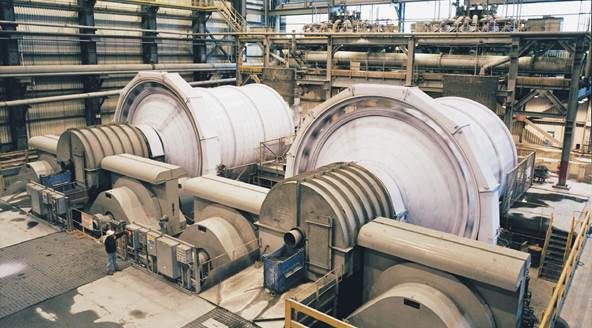 Ball mills (Image credit: Metso)
Buhrstone and disk attrition mills grind media between a horizontal or vertical rotating grooved stone or metal plate and a stationary plate made of similar substance. Buhrstone mills are one of the oldest types of mills used for grinding grains and hard materials. Disk attrition mills are modern versions of the ancient Buhrstone mill.
Vertical shaft mills work on the same principal as VSI crusher, with a rotor on a vertically mounted shaft using centrifugal force to throw the media against a wear plate.
High pressure grinding rollers (HPGR), also referred to as a roller mill or roller press, pulverize material as it moves between two large rollers rotating in opposite directions or a roller and a flat surface. The rolls can be serrated, toothed or smooth.
 Hammer millImpact mills are similar in construction and principal to HSI and VSI crushers. Impact mills are used to pulverize feed material by impact against a surface or a bed of feed material. The feed material may be propelled by gravity or by a rotating impeller or rotor. The impellers or rotors can be vertically or horizontally orientated. Vertical impact mills, cage mills, Bradford breakers, and granulators are usually classified as types of impact mills. Hammer mills are a type of impact mills that utilize fixed or swinging hardened steel hammers, chain or a cage. Hammer mills can be used for coarse crushing or fine grinding, depending on the size and configuration. Hammer mills are available in vertical and horizontal rotor configurations with one to many rows of hammers.
Pin mills utilize a rotor with one or more rows of rods that propel particles into stationary pins or surfaces. Universal mills use interchangeable rotors to allow different types of materials to be processed on the same machine. Universal mills are classified as high speed rotor pulverizers or disintegrators and produce a finer product compared to coarse crushers or impactors.
Selection of the proper crusher, grinding mill or pulverizer is dependent on the material to be processed and the requirements of the end product. Additional factors to consider are the feed size and hardness, whether the feed is wet, dry or both and whether the equipment needs to be operating continuously or in batches.