Windshield Designed for Container Ships
S. Himmelstein | June 01, 2017An in-service test of a wind resistance-reducing windshield for container ships conducted by Mitsui O.S.K. Lines (MOL) (Tokyo, Japan) determined that the device reduces carbon dioxide emissions by an average of 2 percent.
The windshield, co-developed by MOL, was installed on the bow of its MOL Marvel container ship for the trial, 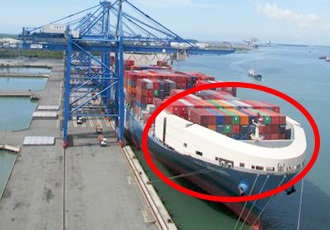 The red circle highlights the windshield installed on the container ship bow. (Source: MOL)which involved sailing at 17 knots per hour during service on Asia-North America East Coast routes. The performance of two sister ships, one with and one without the windshield, was compared.
With today's larger container ships, the height of the containers loaded on their decks has increased, subjecting the vessels to greater wind resistance. MOL recognized the need to address this issue in a cost-effective way. Development of the new device began with an examination of the bow's aerodynamic form through wind tunnel testing.
This led to the adoption of a horseshoe-shaped design, which encloses the front line of the stacked containers to maximize the wind resistance-reducing effect while minimizing the weight of the main unit. The new windshield has enough design strength to meet the ClassNK rules concerning wave impact pressure. By obliquely setting the containers placed along the sides of the vessel behind the windshield, the sides of the vessel are more streamlined, further reducing wind resistance.