CRP USA and Windform®: Offering Materials for Space and Beyond
May 24, 2017Sponsored content
CRP Group (headquartered in Modena, Italy) has an over 45-year history with high-performing CNC machining and over 20 years of experience with additive manufacturing and 3-D printing. An arm of the CRP Group, CRP Technology, was among the first companies specializing in additive manufacturing and 3-D printing in Europe. CRP Group created one of the first 3-D departments staffed with professional printers working in conjunction with an R&D department for material development, giving them the capability to quickly create and manufacture prototypes.
Much of the CRP Group’s success in the aerospace industry is due to their U.S.-based partner, CRP USA. Located in Mooresville, North Carolina, the hub of the growing aerospace and motorsports industries, CRP USA is a manufacturer of on-car and wind tunnel components. Building upon the suite of materials originally created by CRP Technology, CRP USA and the Windform® family of high-performance composite 3-D printing materials have been servicing an array of industries for over a decade.
The SLS (selective laser sintering) products offered under the Windform® suite of materials help to create some of the best finishes and strengths in additive manufacturing. The SLS polyamide-based glass or carbon fiber reinforced Windform® materials have satisfied the needs of the automotive and aerospace industries with their reputation for designing high-performing, durable, and detailed parts. Originally creating parts for race cars, CRP USA, in conjunction with the Windform® product line, are now creating parts for use in space (NASA approved and outgas tested).
CRP USA understands that parts are only as good as the materials used to produce them. Even a great printer can make a bad part if the wrong material is selected. CRP USA works to fit the right material to the intended use based on the features of each product listed below:
Windform® XT 2.0 is a groundbreaking carbon fiber reinforced composite 3-D printing material known for its mechanical properties. Due to its high stiffness and excellent strength, it is the material often used in the motorsports, automotive, and aerospace fields. An important feature: This material has passed the outgassing test conducted by NASA.
Windform® LX 2.0 and Windform® LX 3.0 are composite polyamide-based materials that are reinforced with glass fibers. They are not electrically conductive materials, which makes them safe for electronic applications. Windform® LX 2.0 and Windform® LX 3.0 are also used to create air intake systems, connectors, driver cockpit components, cooling/ducted fans, UAV structural components, and design parts. Windform® LX 3.0 has improved the already excellent performance of Windform® LX 2.0. These improvements can be noticed from a sinterability standpoint. Additionally, they both have a Comparative Tracking Index (CTI) equal to 600. An important Windform® LX 2.0 feature: This material has passed the outgassing test conducted by NASA. This material has also passed skin patch tests, making it an appropriate material for applications requiring skin contact.
 Windform® SP is a material that is useful in applications requiring resistance to impact, vibration, deformation, and high temperatures (i.e., motorsports, automotive and aerospace). The material is also suitable for dyno testing and on-track testing. Important features: This material has passed the outgassing test conducted by NASA and is also waterproof.
Windform® GT is a material used mostly in automotive applications that require specific flexibility both in the car and under the hood (for instance, snap-fit components). It is not electrically conductive, making it safe for electronic applications. Important features: This material has passed the outgassing test conducted by NASA and is also waterproof. This material has also passed skin patch tests, making it an appropriate material for applications requiring skin contact.
Windform® FX BLACK is a material for flexible components and functional parts outfitted with living hinges or clip fittings. The material is appropriate for applications calling for fine details and for accurate and superior definition. The material is also appropriate for use in the motorsports industry (air ducts, intake, and cooling systems).
Windform® RL is a rubber-like material that is used to create prototypes and parts. The material is often used in athletic footwear and equipment requiring flexibility and shock absorption.
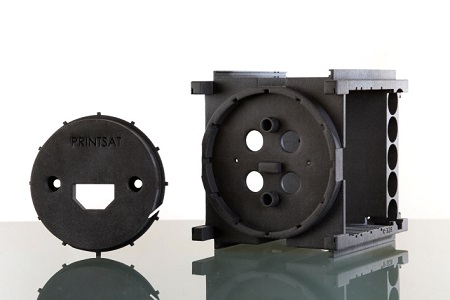 Windform® GF 2.0 is a material meant for objects of design and non-functioning models, prototype intake manifolds, fuel systems, and household items.
The Windform® suite of materials has been used in a variety of applications from the aerospace industry to racing and motorsports. A few examples:
Using Windform® XT 2.0 material, the CubeSat miniature satellite was successfully launched into orbit in 2014. The TuPOD (a unique CubeSat and a dispensing system for two tube satellites), created using Windform® XT 2.0, was also successfully launched into orbit.
Windform® SP was used in creating the intake manifold for Elan Motorsports’ DeltaWing. The DeltaWing, equipped with the Windform® SP intake manifold, revolutionized the motorsports’ industry.