
Video: Paraffin Wax Fuels Hybrid Rocket Engine
S. Himmelstein | May 02, 2017It’s not just an ingredient in candles and crayons: paraffin wax also fuels the Peregrine hybrid rocket motor. In this aerospace engineering project from NASA and Stanford University, the motor uses the wax as a solid fuel, and nitrous oxide as a liquid oxidizer. In March 2017, Peregrine successfully passed its final ground test at NASA’s Ames Research Center in Mountain View, California.
The fuel burns three times faster than conventional fuels, according to Stanford researchers, and can provide more thrust and higher performance than existing hybrid rockets.
Paraffin is non-toxic, which helps make its manufacture and transport cheaper and safer. It can also contribute to an efficient, stable combustion system that provides higher thrust in a compact motor. The paraffin-based fuel works under challenging environmental conditions, like the very low temperatures found on the surface of Mars. The Mars Ascent Vehicle, currently under development by NASA’s Jet Propulsion Laboratory, aims to use the paraffin technology to return a sample from the surface of the planet to an orbiting spacecraft. This technology could also be used on Earth for boosters and sounding rockets with research applications.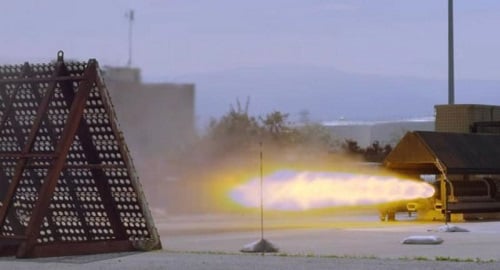 The relatively clean-burning and safe paraffin fuel ignites during Peregrine’s final ground test. Source: NASA Ames Research Center
The Peregrine hybrid rocket is also a simpler system, using roughly half the number of components of a liquid rocket motor. It is also less explosive than its counterparts, using all-solid or liquid propulsion. Since Peregrine’s solid fuel and liquid oxidizer are stored separately in the engine, they are unlikely to mix inadvertently and react.
The project is a joint effort of three Silicon Valley groups – NASA’s Ames Research Center, Stanford University, and Space Propulsion Group, the company that manufactured the combustion chamber – along with NASA’s Jet Propulsion Laboratory in Pasadena, Califonia. NASA plans to test the Peregrine rocket in flight for the first time later this year at NASA’s Wallops Flight Facility, located on Wallops Island in Virginia.



Just curious: is the thrust measured in candlepower? :)
I suspect it would extend the candlepower scale by many orders of magnitude.
A friend of mine is working on a rocket engine for his go-kart. It uses paraffin as the fuel grain. He loaded his engine by spinning it on a lathe, and adding liquid paraffin, at the right rate to make a single congealed ring at the inside diameter, the full length of the oscillator.
This design allows the oxidizer to enter near the nozzle, flow centrally back while spinning to the far end, and then pick up fuel and burn it on the way out, still spinning.
I forgot the name for it, a fairly common design these days, because it is a very stable configuration. The nitrous oxide part of it, he has not yet planned on, as he was going to simply use high pressure oxygen, I think.