Protecting Electronic Equipment from EMI
April 27, 2017Sponsored Content
As electronic devices become more commonly used, there is an accompanying risk that some of this equipment will create electromagnetic interference (EMI), which can be thought of as noise or “electronic smog.” EMI can interfere with system functionality, causing an undesirable response, malfunction or degradation in the performance of electrical circuits. Sources of EMI include (but are not limited to) AC motors, switched-mode power supplies, microprocessors, mobile phones, computers, fluorescent bulbs and ballasts and photovoltaic systems. To maintain complete system functionality, noise cannot be allowed to overwhelm normal operation of electrical circuitry.
An EMI filter circuit accomplishes this task by suppressing, or attenuating, some frequencies with respect to others. It also stops electrical equipment from putting noise onto the power lines. Many countries regulate EMI disturbance immunity and emission before a final product is allowed to be released into the marketplace. That often requires adding an EMI filter to the design.
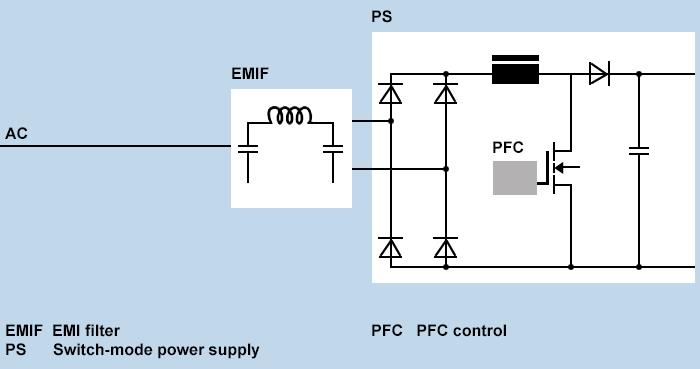 Figure 1: Single-phase power line filter with SMPS to remove common and differential mode noise.
As a rule of thumb, EMI prevention should always go hand in hand with the general design of a product. It is often quite expensive to leave it as the last task to be performed before a product is introduced. From the very beginning, designers should consider which noise sources and susceptible circuits they have in their equipment. This makes it possible to physically separate them and avoid problems right from the start rather than having to fix them later.
Filter Selection Criteria
When selecting EMI filters, many specs and ratings must be considered, including voltage, current, frequency, case size, mounting type, safety agency approval and others. Let’s look at some key parameters one at a time.
- Filter selection often begins by determining the voltage and current requirements of the application. To determine AC voltage, you should consider both line-to-line and line-to-ground voltage. The rated voltage is the voltage for which the EMI filter was designed. Similarly, rated current is the current for which the EMI filter was designed. Current rating requirements can be determined by the maximum current rating specifications of the system it’s connected to.
- Frequency (Hz) and insertion loss (also known as attenuation) characteristics. The effectiveness of noise attenuation is undoubtedly a primary concern for selecting an EMI filter, which is usually required to be effective over a frequency range that has to be specified so the unwanted interference will be rejected. The filter’s capability can be determined by its insertion loss, which is derived from the following formula:
Insertion loss (expressing in decibels (dB)) = 20log V1/V2
Where V1=EMI voltage without a filter and V2=EMI voltage with a filter.
In other words, it’s the ratio of noise that would get through without the filter to that which gets through with the filter installed. Insertion loss data is reported for a filter in a 50 Ω system. Published insertion loss data a 50 Ω-50 Ω circuit. However, this condition seldom exists in an actual application. While this provides a measurable comparison, it should not be taken to reflect the actual performance of the filter in a system. To verify actual effectiveness in noise suppression, a filter has to be mounted in the equipment and be subjected to an emission test in a shielding room.
The actual performance of the filter usually falls somewhere between the worst case and the ideal case.
 Figure 2: Schaffner’s low-leakage EMC/EMI filters feature an ergonomic design.
- Leakage current (mA). Leakage current is the current flowing through the earth ground connection. This can create an electric shock hazard if the system is improperly grounded. Some regulatory agencies will specify the amount of leakage current that is allowed by the filter for safety purposes. For obvious reasons, medical applications present the most stringent standards.
- Number of paths/phases. EMI filters can be single phase, three-phase or DC. When working with single phase AC power, a filter will be required for the power line and its return (two paths in all). Three phase AC power will require a filter for each of the three phase lines and the neutral (four paths in all).
- Size and weight of a filter is determined by the size and quantity of the passive components that go into the filter, which, in turn, is determined by the current rating (Amps) and insertion loss/performance of the filter. The filter's mechanical footprint, including mounting and terminations, may impact the effectiveness of the filter in a system.
- Agency approvals required for proper usage in the end application. Safety agencies define limits for the maximum leakage current, operating temperature rise and the mechanical design.
- Operating temperature. The temperature range the filter was designed to operate correctly.
Standard and Custom Filters
The key reasons for choosing ready-made filters are convenience, compactness and cost. Schaffner’s standard product range is particularly wide, allowing users to select an optimal choice in both performance and cost efficiency; users can usually find an off-the-shelf solution for even the most difficult of EMI problems (to retrofit a solution to an existing design, for instance).
Schaffner's ready-made PCB filters, for example, are designed for compactness and ease of assembly, and avoid the need for extra mounting components and installation operations necessary with chassis styles, but at the expense of finite available space for filtering circuitry. Consequently, they typically offer just a single stage of attenuation for the vast majority of electronic equipment noise problems.
Schaffner also offers chassis-mounting versions for a very wide range of power levels—from less than 1A to 2500A—covering office equipment to industrial applications.
What is more, Schaffner offers a broad selection of standard off-the-shelf power entry/outlet EMI filters and power entry modules making it easy to select the right product for the job at hand. Standard IEC connector filters are a practical solution allowing for a faster EMI approval process. Several Schaffner IEC inlet filter ranges are available as medical versions (B-types where there is a requirement to keep leakage current to an absolute minimum) or with an optional earth line choke (E-types).
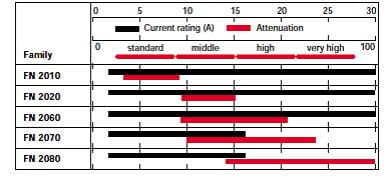 Table 1: Current rating and attenuation performance helps engineers identify which filter family is best suited to their application.
There are occasions where custom designed filters are the only way to meet special electrical, mechanical or performance requirements. Fortunately, Schaffner can also custom design EMI filter solutions to meet international compliance standards, time-to-market constraints and the exact specifications of your application, with full engineering support. A special filter provides the extra benefit of being any shape and size the manufacturer requires, which allows for any termination style and can be tailored for specific performance characteristics.
The Schaffner Advantage
Schaffner boasts a world-class ability to simulate, design and develop prototypes, has extensive knowledge of local regulations and has test and measure facilities with specialist test equipment and application engineering teams distributed throughout the world.
Services available include:
- Rapid prototyping capability
- Testing and emission measurements to EN, FCC or Mil Std
- Engineering support and guidance
- Simulation of electromagnetic fields, temperature and performance
- Simulation of short-term DC or AC mains failures
- Simulation of transient parasitic voltages
- AC and DC insulation testing
- Harmonics instrumentation for current and voltage to the 49th harmonic
In summary, manufacturers can call on Schaffner to support them with their filter requirements from the early stages of new product ideas or designs. The company’s breadth of product, the high attenuation characteristics of its filters under various load conditions, its dedication to quality and, above all, its experience in filter design and manufacturing spanning more than 50 years is your assurance of successfully meeting local and international requirements.
For more information, visit http://www.schaffner.com/.
This article is the first in a series of three articles. Please check Engineering360 soon for the second and third articles in this series.