Deep Learning Algorithm Holds Promise for Drug Development
Nancy Ordman | April 07, 2017A type of machine learning that works well with small data sets holds promise for drug discovery and development. This methodology could be a useful tool for other areas of chemical research.
One-shot learning, a kind of deep learning, differs from other machine-learning approaches in the amount of 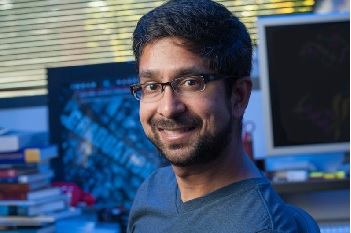 Vijay Pande. Credit: L.A. Cicerodata required to arrive at a solution. Most applications of machine learning, like image recognition, rely on training a set of algorithms with thousands to trillions of data points. One-shot learning can succeed with hundreds of data points.
Drug designers test different combinations of molecules for toxicity and effectiveness. Carrying out this testing using computer algorithms to combine molecules, often closely-related molecules, should be much faster than creating actual compounds and testing them. Researchers are experimenting with other machine-learning approaches, but these methods require substantial datasets.
Stanford University chemistry professor Vijay Pande and his students did not expect a successful outcome when they used one-shot learning with a small set of data points. Since the group already had the data, running a test seemed worth the effort. The results were surprisingly accurate.
First, the team represented the small molecules with graphs, which represented the molecule properties in a way an algorithm could process. Next, they trained the algorithm with toxicity and side-effect information. In post-training testing, the algorithm predicted toxicity and side effects better than chance.
This method is not a silver bullet for drug discovery. It works well for molecules that are closely related and for the particular effect being tested. The research team sees this technique as useful early in the process of drug discovery for selecting a candidate molecule from among several candidates.
“This paper is the first time that one-shot has been applied to this space and it’s exciting to see the field of machine learning move so quickly,” Pande said. “This is not the end of this journey – it’s the beginning.”
Code from this experiment is open source and available as part of the DeepChem library.