Chip May Extend Sensors' Battery Life
Engineering360 News Desk | February 09, 2017A low-cost chip that enables batteries in sensors to last longer, in some cases by over ten times, has been developed by engineers from the University of Bristol (link no longer available; original article was previously found at bristol.ac.uk/engineering).
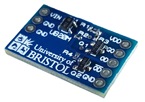 The ultra-low power UB20M voltage detector chip.Bernard Stark and colleagues in the Bristol Electrical Energy Management Research Group at the Merchant Venturers School of Engineering have developed a voltage detector chip that requires only a few trillionths of a watt (picowatts) to activate other circuits. The research group is providing samples of their chip to companies, which will enable engineers to design sensors that continuously listen without using power from a battery or mains.
The result is smaller batteries, or a battery life that may be extended in some cases by years. The voltage detector can also eliminate standby power. For example, the team has demonstrated a television with no continuous draw of power during standby, by using a voltage detector that is powered up at a distance, directly from the infrared signal of a standard TV controller.
The UB20M voltage detector, or keep-alive device, is a chip that, when combined with a suitable sensor, eliminates standby power by enabling zero-power sensing and listening. It allows circuit designers to develop circuits that perform continuous monitoring without using battery power, and to implement wireless wake-up with zero receiver power. The chip is a sensor-driven circuit that requires no power supply; instead it uses a fraction of the power contained in the output signal of the sensor.
Stark says the UB20M voltage detector provides sensing that is continuous and free because it is able to respond to minute quantities of power from unpowered sensors. No battery or other power is needed for the device to stay alive and listening, and battery maintenance is therefore reduced or not needed. Researchers are now actively seeking commercial partners to use the voltage detector chip in their product.