Harvard Unveils Metallic Hydrogen Research
Abe Michelen | February 01, 2017A team of researchers at Harvard University announced that they have fulfilled a more than 80-year-old scientific dream of converting hydrogen into a solid metal. The abundance of this gas and its ease of handling would make this achievement a new source of electric power, among other applications. With only one electron in its valence shell, solid hydrogen could be used to make superconductor zero-resistance electrical wiring at room temperature and can be converted into a very powerful rocket fuel, just to mention two possible applications.
Metallic hydrogen, theoretical proof suggests, might also be metastable. This means that once it is transformed into a metal—even at very low temperatures and high pressure—it will maintain its metallic state after it’s brought back to room temperature conditions. Zero-resistance cables could lead to a revolution in electrical transmission; the electric grid of countries could distribute electrical energy without any losses.
NASA and other institutions in the United States are looking forward to using the material to fuel rockets. Now, super-cool liquid hydrogen is used extensively as fuel to propel rockets, but metallic hydrogen is expected to become an optimal fuel never seen before.
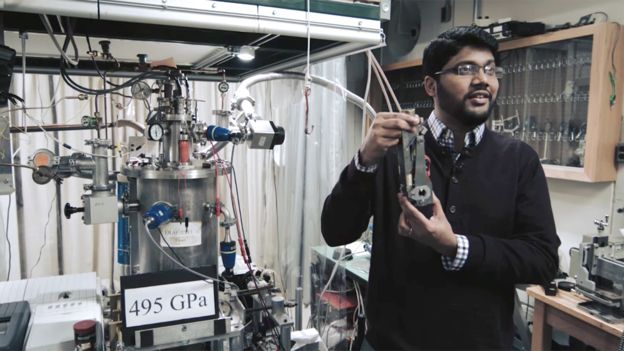 Ranga Dias at his laboratory. Courtesy of Harvard UniversityProfessor Isaac Silvera together with researcher Ranga Dias developed the methodology to create the solid hydrogen in the laboratory. "It's the first time solid metallic hydrogen has ever existed on Earth," Professor Silvera said. The amount of solid hydrogen produced is extremely small—less than the diameter of a human hair—but the experiment is encouraging us to believe that with new laboratory techniques an industrial production can be achieved.
The technique used by the researchers was to apply an enormous pressure to a cell containing a small amount of molecular hydrogen. The cell was placed between two synthetic diamonds, an arrangement called diamond anvil cell (DAC)—used very often in scientific experiments needing high pressure environments—with which they could achieve a pressure of more than 495 gigapascals. This is equivalent to more than five million Earth atmospheres!
This procedure would squeeze the hydrogen atoms so close together so as to form a crystal lattice in order to start sharing their electrons in a similar fashion like copper atoms share their electrons with neighboring atoms. This is precisely a metallic behavior. The ‘eureka’ moment came when the researchers saw that the DAC developed a bright lustrous surface, typical of standard metals. The tiny sample went from transparent, to black, to highly reflective as the pressure was increased. Becoming shiny and reflective is a sign that the material has become a solid metal, the Harvard team claims. Courtesy of Harvard University
"As we turned the pressure up, it went to a transparent molecular solid. And then, as the pressure kept going up, it went black, and we think it goes black because it becomes like a semi-conductor and it can absorb light. And then we turned the pressure up higher and it started shining. It was very exciting. It has extremely high reflectance. The reflectance we measured is about 90%. It's about the reflectivity of an aluminum mirror," Professor Silver described on the British Broadcasting Company (BBC) program Science In Action.
However, many scientists have greatly criticized the results. They do not believe the outcome of the Harvard research, mainly because the article does not include enough quality data to let the scientific community 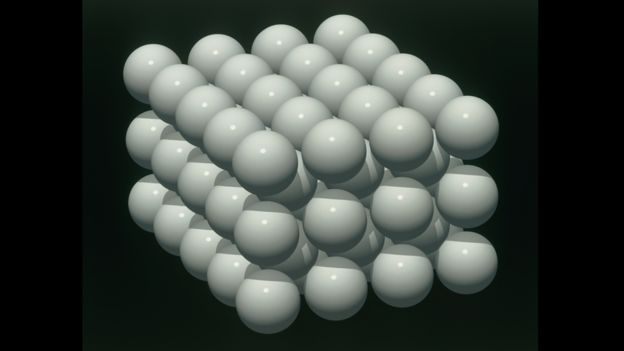 Artwork showing how in a metal, the atoms pack closely together in a lattice arrangement, so they can share electronics. Courtesy of Science magazineassess the results. In a BBC News interview, Professor Eugene Gregoryanz from Edinburgh University stated: "Complete garbage. Like everybody else who works with hydrogen at high pressures, I am appalled by what is being published in Science."
"I understand that others in the DAC community have been rather skeptical (arguing that the apparent reflectivity might be coming from contaminants in the sample, the aluminum oxide coating on the diamonds, etc.). However, if they really have achieved nearly 500 gigapascals in the DAC, it is not unreasonable to have observed a transition to metallic hydrogen,” said Marcus Knudson from Sandia National Laboratories in New Mexico. "The skepticism here is probably a good thing, in that it will drive many groups toward attempting to reproduce this experiment. This publication will certainly incite the field. Again, if it holds up, this is an exciting result. I think in this case time will tell," he added.