
Chasing room-temperature superconductivity
S. Himmelstein | January 16, 2019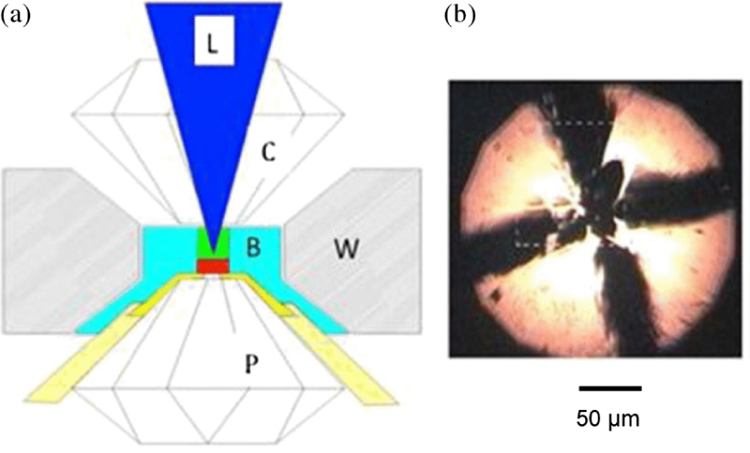 (A) Schematic of the assembly used for synthesis and subsequent conductivity measurements. (B) The piston diamond (P) was coated with four 1-μm thick Pt electrodes which were pressure-bonded to 25-μm thick Pt electrodes (yellow). The 5-μm thick La sample (red) was placed on the Pt electrodes and packed in with ammonia borane (AB, green). Source: George Washington University
Superconductive materials feature zero electrical resistance when cooled below a characteristic critical temperature. The electrical resistance of a metallic conductor decreases gradually as temperature is lowered to -180° C or -292° F, but the need for such low-temperature regimes limits the practicality of most superconductor applications.
The realization of room temperature superconductors would improve power generation efficiency and boost the power of computing systems. Progress in the pursuit of such materials has been published by researchers from George Washington University, Carnegie Institution of Washington and U.S. Argonne National Laboratory. The group synthesized a metallic, hydrogen-rich compound under extremely high pressures of about 2 million atmospheres.
The researchers used diamond anvil cells to generate the elevated pressure levels needed to fuse minuscule samples of lanthanum and hydrogen, which were then heated and characterized. They then heated the samples and observed major structural changes. Researchers had previously posited that the resulting lanthanum superhydride structure would be a superconductor at high temperatures.
While keeping the sample at high pressures, reproducible change in electrical properties was observed as the sample was maintained under high-pressure conditions. Resistivity declines were measured as temperatures dropped below 260 K (-13° C or 8° F) at 180-200 gigapascals of pressure, providing evidence of superconductivity at near-room temperature.
The research is published in Physical Review Letters.
This is awesome! It's on my bucket list to hold a superconductor in my hand! The 200 gigapascals is still a problem, though, but we're getting there!