
Pipelines More Efficient Than Rail for Long-Hauling Oil
John Simpson | January 03, 2017Pipelines are more environmentally friendly than rail when hauling oil and bitumen long distances, according to a new University of Alberta study. After comparing the energy consumed during construction and operation for both transportation methods, researchers in the Faculty of Engineering found that pipeline transportation produced 61%-77% less greenhouse gas emissions than rail.
The findings come in the wake of governmental approval of both the Trans Mountain and Enbridge Line 3 pipelines. If built, the projects will pump nearly a million more barrels of oil per day from Alberta's oil sands to global markets. At that volume, pipelines like the Trans Mountain project would be a lower-emission option than rail, says Amit Kumar, professor of mechanical engineering and lead author of the study.
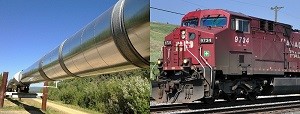 For longer distances and larger volumes of oil and bitumen, pipelines are more efficient and less polluting than rail. Image credit: University of Alberta. “If you’re looking at shorter transportation distances and smaller capacities, rail is probably more efficient," Kumar says. "But most of the crude and bitumen exported from Alberta goes to U.S. refineries, which are long distances and at a large scale,” he says, noting that the Trans Mountain pipeline alone is 1,150 kilometers long and can pump up to 890,000 barrels per day. "When you are looking at longer distances, you have to be energy efficient, and a pipeline can transport much more oil than a railroad can.”
Through computer modeling, the researchers ran scenarios for both rail and pipeline transport of bitumen and crude oil for a range of capacities and distances, evaluating energy use and greenhouse gas emissions for each mode of transportation. They calculated how much energy is put into manufacturing equipment and components of a pipeline, the amount of energy required to transport a barrel of bitumen and the greenhouse gases emitted over that life cycle. The same concept was applied to construction and operation of railroad track, tankers and locomotives.
For amounts over 50,000 barrels of bitumen per day, pipeline is more efficient per unit and greenhouse gas emissions from pipelines can be further reduced if they are pumped using renewable energy such as hydroelectric power.




How does this square with the 4.2 million barrels of oil spilled from pipelines in the US since 1986?
In reply to #1
I thought this article was interesting:
http://www.forbes.co
In reply to #2
The bottom line is that it just doesn't matter what John Q Public thinks, the oil's gonna flow, and the cheapest mode of transportation will be employed no matter what the risk of environmental or human losses are.
We're back to "oil flows where the money goes" and as long as money trumps all else, there will be environmental and human losses. These will be written off as collateral damage in the name of progress, when in reality it's just greed.