
Navy Ship Replaces Valves
Engineering360 News Desk | December 22, 2016The U.S. Navy's USS Independence (LCS 2) has successfully completed the first selected restricted availability works at Southwest Regional Maintenance Center (SWRMC) in San Diego, Calif.
SWRMC supervised the work conducted on the LCS 2 under its contractor, General Dynamics National Steel and Shipbuilding Co. (NASSCO).
The primary work included hull strengthening, waterjet anode pocket and stern tube replacement, as well as replacement of several 10in overboard discharge valves and 12in suction valves.
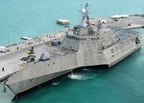 USS Independence completed maintenance work.Other work included air-conditioning plant accumulation tank modification, mission bay stanchion strengthening, and Number 1 and 2 ship service diesel generator (SSDG) top-end overhauls.
The LCS is being built in two variants, with the Freedom type being built and delivered by Lockheed Martin and the Independence type by Austal.
The LCS is designed to perform missions that include countering littoral mine threats, diesel submarine threats, and surface threats, such as small surface craft attacks.
Designed based on a trimaran hull, USS Independence (LCS 2) was launched in April 2008 and commissioned in January 2010.



It makes one wonder about the quality of valves in today's advanced technological world, or maybe the original selection of valves........I served on some older ships in the Royal Australian Navy........I cannot recall ever replacing 10", 12' or larger suction or discharge valves........they were always refitted by ship's staff during the ship's dry docking periods......the only thing that I ever remanufactured for these types of valves was a couple of valve spindles (they had become porous over 20- 25 years of service)........we recut valve seats, lightly machined valve faces, etc., if required, and lapped the valves......these valves were all manufactured from a good quality marine grade bronze. All valves were globe type, screw down/screw lift valves.
I wonder if the valves on these USN vessels are butterfly valves.........that could explain a great deal???