Boosting Heat Transfer in Microelectronics
John Simpson | December 20, 2016Bumpy surfaces with graphene in-between could help dissipate heat in next-generation microelectronic devices, according to Rice University scientists.
Computer models were used to simulate the replacement of the flat interface between gallium nitride semiconductors and diamond heat sinks with a nanostructured pattern—and the addition of a layer of graphene between the two surfaces. The studies showed that enhancing the interface between these materials would allow phonons—quasiparticles of sound that also carry heat—to disperse more efficiently.
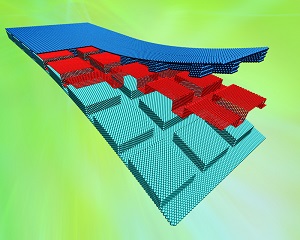 Simulations showed that graphene between patterned gallium nitride and diamond could offer excellent heat transfer in next-generation hybrids of nano- and microelectronics. Image credit: Lei Tao/Rice University. “With the current trend of constant increases in power and device miniaturization, efficient heat management has become a serious issue for reliability and performance,” says Rouzbeh Shahsavari, assistant professor of materials science and nanoengineering. “Oftentimes, the individual materials in hybrid nano- and microelectronic devices function well, but the interface of different materials is the bottleneck for heat diffusion.”
Gallium nitride has become a strong candidate for use in high-power, high-temperature applications such as uninterruptible power supplies, motors, solar converters and hybrid vehicles, Shahsavari says. And while diamond is an excellent heat sink, its atomic interface with gallium nitride is hard for phonons to traverse.
The researchers simulated 48 distinct grid patterns with square or round graphene pillars and tuned them to match phonon vibration frequencies between the materials. Sinking a dense pattern of small squares into the diamond produced a decrease in thermal boundary resistance of up to 80%. A layer of graphene between the materials further reduced resistance by 33%.
“With current and emerging advancements in nanofabrication like nanolithography, it is now possible to go beyond the conventional planar interfaces and create strategically patterned interfaces coated with nanomaterials to significantly boost heat transport,” Shahsavari says. “Our strategy is amenable to several other hybrid materials and provides novel insights to overcome the thermal boundary resistance bottleneck.”