First Citywide Test of Radioactivity
John Simpson | November 30, 2016On a recent fall day in Washington, D.C., several hundred volunteers—each toting a backpack containing smartphone-sized radiation detectors—walked for hours around the National Mall. The exercise, sponsored by the Defense Advanced Research Projects Agency (DARPA), provided the largest test yet of the agency's SIGMA program, which is developing networked sensors that can provide real-time radiation detection over large urban areas.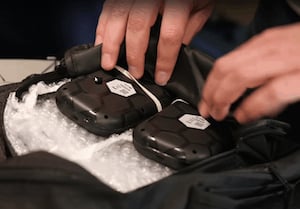 A participant packs smartphone-sized radiation detectors in a backpack. Image credit: DARPA.
A key element of SIGMA, which began in 2014, has been to develop and test low-cost, high-efficiency radiation sensors that detect gamma and neutron radiation. The detectors, which do not themselves emit radiation, are networked via smartphones to provide city, state and federal officials real-time awareness of potential nuclear and radiological threats such as dirty bombs, which combine conventional explosives and radioactive material to increase their disruptive potential.Following a demonstration earlier in 2016 with the Port Authority of New York and New Jersey involving more than 100 SIGMA sensors, the 1,000-detector deployment in Washington, D.C. marked the largest number of SIGMA mobile detectors ever tested at one time and was a demonstration of the program’s ability to fuse the data provided by all those sensors to create minute-to-minute situational awareness of nuclear threats. The SIGMA research team was able to evaluate how well the devices functioned as mobile nodes on a network that stretched to about five square miles.
“The SIGMA system performed very well, and we collected and analyzed a huge amount of streaming data as we watched in real-time as participants covered a large portion of D.C.,” says Vincent Tang, DARPA program manager.
Next steps in the SIGMA program include continuing to test full city- and regional-scale, continuous wide-area monitoring capability in 2017 and then transitioning the system to local, state and federal entities in 2018.