The New "Fog of War?"
John Simpson | November 21, 2016German and Polish scientists are proposing the use of phosphorus nitride as a safe alternative to red phosphorus formulations for use as an obscurant in military and some civilian applications.
Obscurants create an aerosol cloud that can be brought into the line of sight between an observer and a target. The most common source for pyrotechnic obscurants is powdery red phosphorus, although it can be unsafe to handle, burns relatively sluggishly, and can release toxic phosphine.
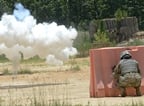 Obscurants are used in military applications. Image source: U.S. ArmyResearchers led by Ernst-Christian Koch, from Lutradyn-Energetic Materials Science and Technology, and Stanisław Cudziło, from the Military University of Technology, in Warszawa, Poland, have examined the performance of phosphorus(V) nitride, P3N5, in typical pyrolant formulations, for example, mixed with an oxidant such as potassium nitrate.
At ambient temperatures, P3N5 is a crystalline powder. Upon ignition, the researchers found the phosphorus sublimes and undergoes combustion into its oxide, which serves as the actual aerosol-generating machine by taking up large amounts of water from atmospheric air. The resulting smog of phosphoric acid and water microdroplets was found to act as an effective concealer.
The scientists report three primary advantages of phosphorus(V) nitride over red phosphorus.
First, the nitride ignites quickly, with burn rates two orders of magnitude greater than those obtained with state-of-the-art red phosphorous/potassium nitrate-based pyrolants. Second, it does not hydrolyze to highly toxic and flammable phosphine. Third, it is resistant to friction, an important characteristic.
"Phosphorus(V) nitride is safe to handle with a range of oxidizers, including chlorates, perchlorates and nitrates," the researchers report. Thus, unlike red phosphorus, there is likely no need to add substantial amounts of protective fillers, such as graphite, to the formulation.