"Optofluidic" Tech Makes for Highly Acute Sensing Device
John Simpson | November 21, 2016Researchers at Oregon State University (OSU) have combined the diatom, a type of phytoplankton, with a version of inkjet printing and optical sensing to create a highly acute sensing device with potential applications ranging from health monitoring to environmental protection.
The “optofluidic” technology combines advanced optics with a fluidic system to identify chemical compounds. With most conventional systems of this type, fluids must flow over a surface, which limits the transport of specific molecules that can be identified.
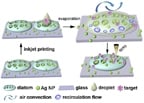 Illustration of how the optofluidic sensor operates. The diatoms in this technology, however, act as natural “photonic crystals.” They harness the forces of convection against diffusion to help accelerate and concentrate molecules in a space where photons from optical sensors can become trapped and interact with and identify the compound through optical signatures.
“A diatom is a natural, living type of phytoplankton that creates very precise, tiny structures,” says Alan Wang, assistant professor of electrical engineering. “When liquids are deposited on it with carefully controlled inkjet devices, the droplets evaporate quickly but, in the process, carry the molecules of interest to the diatom surface. This is the key to increasing the sensitivity of the photonic measurements.”
The sensor technology, the researchers say, can identify what compounds are present and approximately how much of each.
In one demonstration, the scientists tried to identify trinitrotoluene, or TNT, a common ingredient in explosive devices. TNT is a chemical with low volatility, meaning it has limited evaporation, and comparatively few molecules escape that could allow detection.
The new technology was one million times more sensitive at identifying TNT than other common approaches, Wang says. A monitor based on this approach, which could be fast and accurate in military situations, may help save lives, he says.
“Some existing sensors can detect compounds at levels of one part per billion, which sounds pretty good, but for many purposes that’s not good enough,” says Wang. “With this approach, we can detect some types of compounds at less than one part per trillion, about the level of a single molecule in a small sample. ”
Commercial applications of the technology are being explored, OSU says.