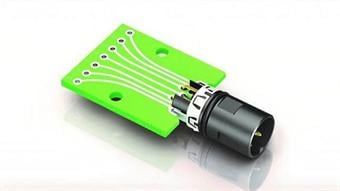
"Bionic" Chip Will Aid Study of Neurological Diseases
John Simpson | November 14, 2016To study how the brain controls such functions as reflexes, learning and memory, the activity of large networks and groups of neurons must be recorded.
A new technology known as a bionic hybrid neuro chip has now been shown to be able to record activity in animal brain cells for weeks, and at a much higher resolution, compared with just minutes at a time for conventional methods. The chip will allow researchers to investigate and understand in greater depth, in animal models, the origins of neurological diseases and conditions such as epilepsy, as well as other cognitive functions such as learning and memory.
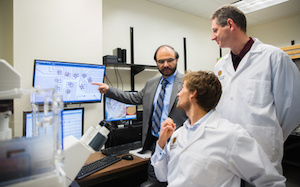 (L-r): Naweed Syed, scientific director of the University of Calgary Cumming School of Medicine’s Alberta Children’s Hospital Research Institute; Pierre Wijdenes, PhD student in the Biomedical Engineering Graduate Program; and Colin Dalton, adjunct professor in the Department of Electrical and Computer Engineering. Image credit: Riley Brandt.“These chips are 15 times more sensitive than conventional neuro chips,” says Naweed Syed, scientific director at the University of Calgary Cumming School of Medicine’s Alberta Children’s Hospital Research Institute, which helped develop the technology. "This allows brain cell signals to be amplified more easily and to see real-time recordings of brain cell activity at a resolution that has never been achieved before.”
A cross-faculty team created the chip to mimic the natural biological contact between brain cells, essentially tricking them into believing they are connecting with other brain cells. As a result, the cells immediately connect with the chip, thereby allowing researchers to view and record the two-way communication that would go on between two normally functioning brain cells.
“We simulated what Mother Nature does [and] provided brain cells with an environment where they feel as if they are at home,” says Syed. “This has allowed us to increase the sensitivity of our readings and help neurons build a long-term relationship with our electronic chip.”
While the chip is currently used to analyze animal brain cells, the increased resolution and ability to make long-term recordings are bringing the technology one step closer to being effective in recording human brain cell activity.
“Recording this activity over a long period of time allows you to see changes that occur over time, in the activity itself,” says Pierre Wijdenes, PhD student in the Biomedical Engineering Graduate Program. “This helps to understand why certain neurons form connections with each other and why others won’t.”