A Solution for Phantom Load
John Simpson | November 14, 2016According to the National Resource Defense Council, Americans waste up to $19 billion annually in electricity costs due to “vampire appliances”—always-on digital devices in the home that suck power even when they are turned off.
Now, University of Utah scientists led by Massood Tabib-Azar, professor of electrical and computer engineering, have come up with a way to produce microscopic electronic switches for appliances and devices that can grow and dissolve wires inside the circuitry that instantly connect and disconnect electrical flow. With this technology, consumer products such as smartphones and computer laptops could run at least twice as long on a single battery charge, and newer all-digital appliances such as televisions and video game consoles could be significantly more power efficient.
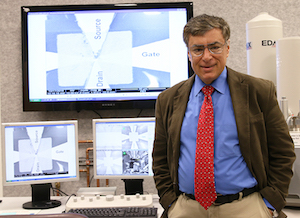 Massood Tabib-Azar, professor of electrical and computer engineering at the University of Utah, has devised a solution for devices that suck power even when they are turned off. Image credit: Dan Hixson/University of Utah College of Engineering.To operate different functions, all electronics have switches that instantaneously turn electrical flow on and off throughout the circuitry, much like turning a light switch on and off. But unlike a mechanical switch, these solid-state switches waste small doses of electricity while they are in a waiting state.
“Whenever they are off, they are not completely off, and whenever they are on, they may not be completely on,” says Tabib-Azar. “That uses battery life. It heats up the device, and it’s not doing anything for you. It’s completely wasted power.”
Tabib-Azar and his team have devised a new kind of switch for electronic circuits that uses solid electrolytes such as copper sulfide to literally grow a wire between two electrodes when an electrical current passes through them, turning the switch on. When the polarity of the electrical current is reversed, the metallic wire between the electrodes breaks down—leaving a gap between them—and the switch is turned off. A third electrode is used to control this process of growing and breaking down the wire.
“The distance between the two electrodes where the wire is grown can be as little as a nanometer long, which is as thin as 1/100,000 of the diameter of a hair,” Tabib-Azar says.
Consequently, billions of these switches could be built onto a computer processor or in solid-state memory chips such as the RAM in a laptop computer. In a smartphone, for example, this technology could be employed in the communications circuitry of the phone, which typically wastes battery power while it is in a state waiting to be used.
Besides better power efficiency, another advantage of this technology is it would produce less heat in the appliance or device because less electrical current is constantly running through its circuitry. Heat buildup has been a problem particularly with laptops and phones and can affect the reliability of components over time.
Tabib-Azar adds that this process doesn’t require expensive retooling of manufacturing plants to implement it because these plants already use materials such as copper sulfide in the manufacturing of electronics.
As of now, the only disadvantage to this process is that it is slower than typical switches in regular silicon-based electronics because of the time it takes to grow and break down the wires. But Tabib-Azar expects to overcome this issue as he and his researchers continue to optimize the process. He also says this technology could be used for devices in which battery power, but not speed, is a priority.