New System Leads to Shorter Production Times
Dan Heilman | October 25, 2016In its effort to shorten lead times without sacrificing quality, Aztalan Engineering came up with a method that took four machines that were being used for long-term production runs and combined them into a dedicated short-run rapid prototyping cell.
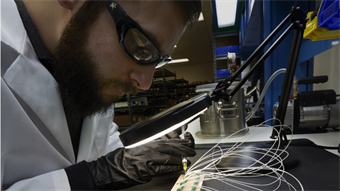
 Aztalan Engineering’s quality control department. The idea became part of a Quick Response Manufacturing (QRM) strategy that may become more common with manufacturers that are faced with productivity increases and shorter expected lead times from customers. Using the short-run cell caused Aztalan to move from a standard manufacturing method that sees parts move from station to station on a shop floor to a more cellular type of manufacturing.
Machines involved in the cell were a Hardinge Conquest super-precision, single-spindle lathe with a single turret; an Okuma LB3000EX; a five-axis Hermle milling center; and an Okuma Genos M460 vertical mill. To construct the short-run cell, Aztalan moved four machines into a U-shaped configuration in the middle of the floor. By using the machines as a mechanized team, job features can be more closely coordinated and the machines can complement each other.
Aztalan Engineering has manufactured precision machined parts globally since 1978. It previously had operated as a traditional contract manufacturer, mostly in the medical device industry. The company no longer needs to interrupt longer production runs to fill smaller orders. A milling center that previously was used for a typical run of up to 200 pieces can now host production runs for 20 pieces.
Smaller runs also have meant a smaller budget for inventory. The company tells Modern Machine Shop that in the first year of running smaller batch sizes, its finished-goods inventory was reduced by more than $1 million.