Digitization turns 50-year-old Wabtec plant into smart super facilities
Engineering360 News Desk | October 04, 2021Over the last few years, investments have enabled Wabtec to position its Grove City, Pennsylvania plant into what the company calls “brilliant factories.”
Grove City is home to two Wabtec plants, employing roughly 1,000 people. The engine plant is a 440,000 square foot facility responsible for engine assembly, machining and testing of a variety of Wabtec products. With a total production of over 3,000 engines a year, it is one of the largest locomotive diesel engine manufacturing sites in the world, 60% of which go overseas.
Source: IndustryWeek
Wabtec has five main platforms it uses to serve the marine and locomotive freight space and the stationary power space. Today, engineering advances enable Wabtec to meet tier four emission standards in the U.S., as well as similar standards in Europe, making it one of the few large diesel engine manufacturers doing so without using aftermarket treatments like diesel exhaustion fluid (DEF) or urea. Being the only provider to have a non-urea, non-DEF solution in the marine space has caused a lot of different companies to look at Wabtec differently, as a cleaner solution – not only meeting stringent requirements but saving money as well.
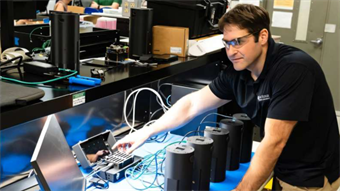
But what makes these plants brilliant? As with many transformations taking place today, digital technology takes center stage including a mix of big data, software, sensors, controllers and robotics. Some specific technology includes a camera detection system to automatically detect production progress; smart tools like position sensing torque tools to provide an ergonomic advantage, and error-proof critical manufacturing processes; digital smart gauges eliminating operator keystrokes and providing a more consistent, error-proof way to measure quality; RFID technology to automatically track the position and location of critical assemblies and parts as they flow through lines; and the ability for plant staff to check the current status of any machine, cell or line from their mobile devices in real-time. When coupled with a lean culture, these fully integrated systems are unlocking significant productivity improvements including a 20% reduction in unplanned downtime and 10% productivity improvement for shop floor connected machines.
Metal additive has also been a game-changer, explains Marty Thomas, Wabtec group vice president for services. “Our additive lab can rapid prototype a part in a day,” he says. “Obviously, we would love additive manufacturing to start to be cost-efficient enough for us to be able to run production runs, but it’s now quite there yet. Having metal spray additive capability here allows us to remanufacture engines and add metal to existing parts rather than scrapping an old part.”
Additionally, digital twin technology has allowed Wabtec to create a true digital footprint using several digital threads to power comprehensive reliability and predictive models – representing a step function change foundationally for the manufacturing, allowing it to competitively overhaul engines while installing fewer new parts during the remanufacturing process.
Read more about Wabtec's quest to digitize more of its facilities.