Artificial Intelligence Could Help Diagnose Crop Diseases
John Simpson | October 17, 2016A network of computers can learn to recognize specific plant diseases with a high degree of accuracy, potentially paving the way for field-based crop-disease identification using smartphones, according to a team of researchers at Penn State University (PSU) and the Swiss Federal Institute of Technology (EPFL).
Identifying a disease correctly when it first appears is a crucial step for effective disease management, according to study David Hughes, assistant professor of entomology and biology at PSU. With the proliferation of smartphones and recent advances in computer vision and machine learning, disease diagnosis based on automated image recognition, if technically feasible, could be made available on an unprecedented scale, he says.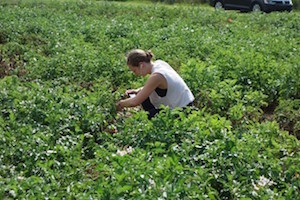 Kelsey Pryze, PSU undergraduate researcher, captures photographs of potato leaves at the Russell E. Larson Agricultural Research Center at Rock Springs. Image credit: Penn State/EPFL.To test this idea, the researchers built a neural network—a large cluster of computers with graphical processing units. Using a deep-learning approach, they fed more than 53,000 images of diseased and healthy plants into the network and trained it to recognize patterns in the data.
"Neural networks provide mapping between an input, such as an image of a diseased plant, to an output, such as a crop-disease pair," says Marcel Salathé, head of EPFL's Laboratory of Digital Epidemiology. "Deep neural networks recently have been applied successfully in many diverse domains. These networks are trained by tuning the network parameters in such a way that the mapping improves during the training process."
The images used in the study depicted 14 crop species—both healthy and with disease symptoms—and 26 diseases. All of the images were assigned to one of 38 classes, each representing a crop-disease pair, and the researchers measured the performance of their model in placing images into the correct class.
The model achieved an accuracy rate of 99.35%, meaning it correctly classified crop and disease from 38 possible classes in 993 out of every 1,000 images.
According to the researchers, while building the algorithms and training the model require significant computing power and time, once the algorithms are built, the classification task itself is very fast. The resulting code is small enough to easily be installed on a smartphone.
The researchers point out that this approach is not intended to replace existing solutions for disease diagnosis, but rather to supplement them. However, they add, the technology could have particular benefits for producers in developing countries, such as in sub-Saharan Africa, that often do not have the research infrastructure or agricultural extension systems to support smallholder farmers.