Nuclear Weapon's Safety Mechanisms Tested in Simulated Accident
John Simpson | October 14, 2016Sandia National Laboratories has sent a mock B61-12 nuclear weapon speeding down a 10,000-foot rocket sled track to slam nose-first into a steel and concrete wall—allowing engineers to examine safety features inside the weapon designed to prevent inadvertent nuclear detonation.
The test, part of a B61-12 abnormal environments series, used a unit resembling an actual weapon to the greatest extent possible, says test director Jason Petti. The high-fidelity unit contained standard components that make up a weapon—explosives and other hazardous materials—but no enriched uranium or plutonium.
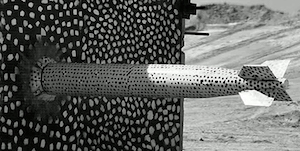 A B61-12 test unit slams into a target at the end of a rocket sled track in a complex forward ballistics test. Image credit: Sandia National Laboratories. The complex forward ballistic test used rocket motors to accelerate the sled along the track, releasing the B61-12 unit to a free-flight crash. The simulated accident collected data, now under analysis, designed to measure whether the weapon met its safety requirements.
Video of the test can be viewed here.
Analyzing potential chemical, explosive and mechanical hazards allows the team to identify “what-can-go-wrong scenarios,” such as how a sudden fire might affect the sensitivity of explosives used in the test. And while test results help improve solid mechanics models, owing to the expense of testing and its inability to recreate every possible accident scenario, computer models fill in the gaps by simulating other scenarios.
The test unit carried an internal data recorder, hardened so it could measure what happened during the impact and gather data to validate computer models. In earlier reverse ballistic tests, cables connected sensors and recorders to a stationary test unit. However, the recorder was onboard for the forward ballistics test because it is impossible to attach cables to a unit speeding down a track.
The recorder contained its own battery, requiring extra safety oversight since the battery power was compatible with the rocket motors’ ignitors—meaning a rocket motor would ignite if there was an electrical path between the battery and the motor’s initiator, Petti says. The team built in multiple barriers to prevent unintentional ignition, he adds.
Test preparations took more than a year and included a calibration test on the track in December 2015 using a B61 trainer—a shell the same weight as a real weapon—to assess plans for the actual test. The calibration test proved the test setup and gave the team the confidence they could provide the needed impact velocity.