A Simpler Process for Creating Alcohols and Aldehydes
John Simpson | October 13, 2016A Washington State University (WSU) research team has used a simple, common industrial process in a new way to create chemicals used widely as fuel additives and as feedstock for plasticizers, detergents, lubricants and cosmetics.
Using the Fischer-Tropsch process to make alcohols and aldehydes in large amounts could lower the cost and energy required to produce these chemicals and possibly provide cleaner manufacturing, according to the researchers.
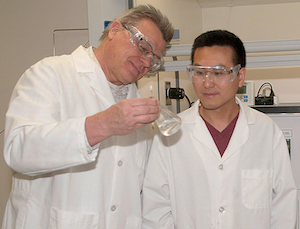 Norbert Kruse, professor in the School of Chemical Engineering and Bioengineering (l), and postdoctoral fellow Yizhi Xiang. Image credit: WSU.Current industrial processes to make alcohols and aldehydes require starting with a complex, petrochemical-based target molecule, an olefin, which is then converted to liquid chemicals in several complicated steps. By contrast, the Fischer-Tropsch process is a chemical reaction that uses catalysts to convert two gases—carbon monoxide and hydrogen—to liquid fuels in a simple, one-step process. It has been used for almost a century to create liquid fuels, which are made of long chains of molecules containing only carbon and hydrogen.To make the alcohols and aldehydes in the one-step Fischer-Tropsch process, the WSU researchers used a catalyst made of cobalt, manganese and potassium. To form the liquid, the two gases react at the surface of the solid catalyst.
“The catalyst preparation is really important,” says Norbert Kruse, professor in the School of Chemical Engineering and Bioengineering. “And the chemistry aspect is wonderful: starting with only two gases, we end up with a technically useful liquid that you usually obtain only after a number of steps in petrochemical refining. I think there is a good chance for industrial implementation.”
Both cobalt and manganese are abundantly available, and the entire process could be significantly less expensive than more complicated methods, according to the researchers. They also determined that they can create different amounts of chemicals by varying the ratio of the carbon monoxide and hydrogen gases.
The researchers have started working with industry partners to commercialize their method.