A Halogen-Free Plastic Solar Cell
John Simpson | October 10, 2016Researchers from North Carolina State University (NCSU) and the Chinese Academy of Sciences have created an efficient, semi-printed plastic solar cell without the use of environmentally hazardous halogen solvents. The solar cells can be manufactured at room temperature, which has implications for large-scale commercial production.
Plastic solar cells, or organic photovoltaics, are popular because they are lightweight, flexible, transparent and inexpensive to manufacture, making them useful in multiple applications. Unfortunately, the halogen-containing solvents used in their manufacture are an obstacle to large-scale commercialization. These solvents are key to making sure that the solar cell’s morphology, or structure, maximizes its energy efficiency; however, they are environmentally hazardous. Additionally, the use of these harsh chemicals requires a controlled environment, which adds to production costs.
Long Ye, a postdoctoral research scholar in physics at NCSU, wanted to determine if nontoxic solvents could provide equally efficient morphology in the manufacturing process. Ye and colleagues developed a proof-of-concept semi-printed plastic solar cell that utilized o-methylanisole (o-MA) as the solvent. Commonly used as a flavoring agent in foods, o-MA is nontoxic to humans.
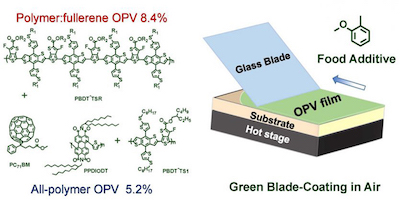 Schematic illustration and chemical structure of semi-printed plastic solar cells in air, using the food additive o-MA as a solvent. Image credit: Long Ye/NCSU. The researchers used soft X-ray techniques to study the morphology of their solar cell. They found that the o-MA-based solar cell has similar morphology, crystalline features and device performance to those produced by halogenated solvents. The solar cell’s overall efficiency rating is around 8.4%.
Furthermore, their cell can be produced via blade coating at room temperature. Blade coating is a process that uses a glass blade to spread a thin layer of the photovoltaic film onto either a rigid or flexible substrate, and the process is compatible with large-scale commercial manufacturing.
“Two of the key requirements for mass producing these solar cells are that the cells can be produced in the open-air environment and that the process doesn’t pose health or environmental hazards,” Ye says. “Hopefully, this work can help pave the way for printing solar cells in ambient air.”