Adaptive Technology Aids Vehicle Steering, Ford Says
John Simpson | October 04, 2016Ford Motor Co. says it is using adaptive steering technology to make its F-Series Super Duty pickup and Edge SUV easier to steer at all speeds.
Despite the industry shift to electrically assisted steering, most new vehicles sold have fixed steering gear ratios. Fixed steering ratios—namely, the correlation between the turn of the steering wheel (in degrees) and the turn of the wheels—represent a compromise between providing steering quickness and maneuverability at low speeds, while offering comfortable vehicle response at high speeds.
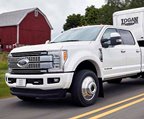 The system comprises an electric motor, a small computer and a gear unit. Adaptive steering "removes these compromises," Ford says, and reduces driver fatigue, particularly at low speeds.
The system—contained in the steering wheel—comprises an electric motor, a small computer, and a gear unit. Based on driver input and vehicle speed, adaptive steering can add or subtract rotations at the steering wheel. Up to one full revolution can be saved at low speeds when steering lock-to-lock.
At low speeds, the system increases the angle of the front wheels as the steering wheel is turned. This results in the driver needing to steer less to maneuver, says Lodewijk Wijffels, Ford adaptive steering technical specialist. “At high speeds, the ratio is changed in such a way that vehicle response is more relaxed, more precise and smoother than without the system,” he says.
Ford says its Super Duty truck also features a specific setting for engaging tow/haul mode that further optimizes how the vehicle and trailer react to steering inputs.