Warming Climate Impact on Power Plant Output
John Simpson | September 07, 2016Future climate warming will likely cause only minor reductions in energy output at most U.S. coal- and gas-fired power plants, a Duke University study has found.
The study, which was based on real-world data, rebuts recent modeling-based research that warns rising temperatures will significantly lower the efficiency of power plants’ cooling systems, thereby reducing plants’ energy output. Some of those studies estimated that plant efficiencies could drop by as much as 1.3% for each 1 degree Celsius of climate warming.
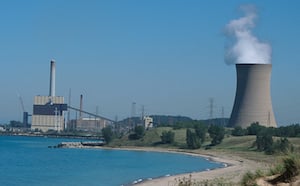 The study incorporated closed-loop and open-loop plants with output capacities of up to 3,000 megawatts. Image credit: John J. Mosesso/USGS.“Our data suggest that drops in efficiency at plants with open-loop, or once-through, cooling systems will be a full order of magnitude smaller than this,” says Candise Henry, a doctoral student at Duke’s Nicholas School of the Environment. Reductions at plants with wet-circulation, or closed-loop, systems—which can be identified by their cooling towers—may be even smaller, she says.
To conduct their study, the researchers analyzed hourly temperature and humidity data recorded at National Climatic Data Center stations and U.S. Geological Survey river gauges near 39 U.S. coal- and natural gas-fired power plants over a 7- to 14-year period. By correlating this data with the plants’ hourly heat-input and energy-output records, they were able to extrapolate how much of each plant’s output was the result of daily and seasonal variations in temperature.
To ensure a representative sample, the study included both closed-loop and open-loop plants from the Northeast, Mid-Atlantic, Southeast, Midwest, Deep South, Great Plains and Rocky Mountain regions. Output capacities ranged from less than 500 megawatts up to 3,000 megawatts.
The cooling efficiency and energy output of every plant—regardless of location, generating capacity or fuel type—was found to be more resilient to climate warming than previous studies predicted. Plants with closed-loop cooling systems were found to be particularly resilient.
“This provides additional rationale for section 316b of the EPA’s Clean Water Act,” says Lincoln Pratson, professor of earth and ocean sciences. “The EPA enacted section 316b to protect fish, shellfish and other aquatic animals from being pulled into, and harmed or killed, in power plants’ cooling water-intake structures. Our study shows it could also provide the added benefit of helping protect the power plants themselves from the impact of climate warming.”
The new findings do not, however, signal an all-clear for the power industry, the Duke researchers caution.