Workshops Impart Lessons
John Simpson | September 07, 2016Reactor safety experts from Sandia National Laboratories and elsewhere are sharing lessons learned from the Fukushima Daiichi nuclear accident and other severe accidents that pushed nuclear power plants past their limits.
The workshops attempt to demystify what happens during an accident to help engineers/operators learn what decisions they might need to make in the event of a plant mishap and to provide insights into the non-intuitive nature of accidents. To date, workshops have been held in Taiwan, Japan and at Sandia and elsewhere in the U.S., with more workshops planned for Switzerland, Mexico, Spain and the United States.
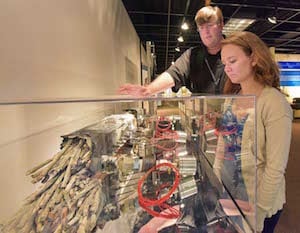 Sandia nuclear engineer Douglas Osborn and student intern Anastasia Fox. Image credit: Randy Montoya.Not all plant accidents are the same, and some things about Fukushima were surprising. The are passing on what they know to operators and engineers through the Technical Support Guidelines Skillset Workshops, developed by the General Electric Boiling Water Reactor (BWR) Owners’ Group.
“Pumps that should have failed in a few hours ran for days, well beyond their expected design basis,” says Douglas Osborn, a nuclear engineer at Sandia. Osborn says that in the Fukushima accident, the expected reactions that create hydrogen led to explosions in the Units 1, 3 and 4 reactor buildings.
“As the core heated to temperatures of more than 1,800 degrees Fahrenheit, the fuel cladding metal reacted with the steam in an exothermic oxidation reaction, leading to rapid temperature increase to the point where water didn’t provide sufficient cooling and created large amounts of hydrogen. The cladding and fuel began to melt, while cladding oxidation continued,” Osborn says.
Many of the accident progressions are still being analyzed with the data from the Fukushima accident to determine the conditions of the core and provide insights that will help engineers and operators prevent another accident.