Low-Power Smart Camera "Awakens" to Specific Gestures
John Simpson | August 25, 2016A smart camera that tracks motion 24 hours a day, but "wakes up" to record in full definition only when it recognizes specific gestures or movement, could process and transmit imagery while operating largely on passive power.
Researchers at the Georgia Institute of Technology have designed such a technology by combining low-power hardware and energy-efficient image-processing software. They say the camera could have applications ranging from remote-area operation, where energy efficiency is critical, to specialized surveillance, robotics and consumer electronics with hands-free operation.
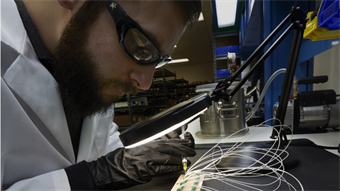
 Researchers at Georgia Tech’s School of Electrical and Computer Engineering have developed a low-power camera capable of recognizing gestures. Image credit: Rob Felt, Georgia Tech.“Right now, cameras are very hard to run on passive power just because they burn so much power themselves,” says Justin Romberg, professor in Georgia Tech’s School of Electrical and Computer Engineering. “This combination of efficient signal processing and a novel hardware design lowers the power requirement and means that some of these other options to power it might be open.”
While reducing the frame rate of a camera plays a role in lowering power demands, to achieve the power savings needed for this project, the researchers programmed the camera to track motion in a more generalized way that still preserves crucial details about what is being tracked. That requires much less power to process than tracking individual pixels throughout the entire field of view.
“We wanted to devise a camera that was capturing images all of the time, and then once you have a particular gesture—like you write a Z in the air—it’s going to wake up,” says Associate Professor Arijit Raychowdhury. “To make that work without affecting the battery life, we wanted it to be so low power that you can power it with harvested ambient energy, such as with a photovoltaic cell.”
While there are commercial products that support simple motion detection, existing technology cannot detect specific patterns in motion or gestures, the researchers say. So motion-detector cameras wake up more often even when they don't need to, and that consumes power.