Haptics Research Could Lead to Advanced Touchscreens
John Simpson | August 19, 2016Haptics researchers have long debated why applying ultrasonic vibrations to a flat, featureless glass plate makes it feel slippery. Northwestern University researchers have now discovered that the vibrations reduce friction by causing the fingertip to bounce on pockets of trapped air—a finding that they say could lead to the design of touchscreens with greater functionality.
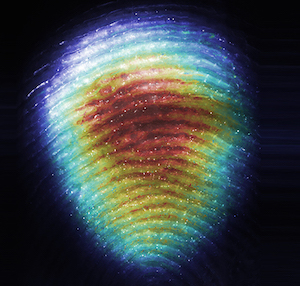 Warmer colors indicate areas where the vibration-induced air cushion is stronger. Image credit: M. Wiertlewski/CNRS. J. Edward Colgate, professor of mechanical engineering, aims to redefine the way users interact with their touchscreens. With Michael Peshkin, also a professor of mechanical engineering at Northwestern, he and his team created the TPad phone, a standard smartphone nestled in a case that enables physical textures to be communicated through the screen. Ultrasonic vibrations in the glass modulate the friction between it and the finger, causing the screen to feel sticky, slippery, bumpy or wavy.
The lack of understanding of the underlying mechanism that makes the screen feel slippery posed a barrier to furthering the research. Earlier studies showed that when objects, such as metal discs, were placed on a vibrating screen, they floated above it. Haptics researchers were hesitant to apply these findings to a finger.
But fingers are different, says Colgate. “They’re not hard or rigid, and they’re rough because of the fingerprint and build-up of dead skin cells. We’ve been trying to understand this phenomenon for a number of years, but the kind of instruments we needed weren’t available.”
Michaël Wiertlewski, a former postdoctoral fellow in Colgate’s laboratory, overcame this hurdle by building an apparatus to image the finger as it experiences the ultrasonic vibrations, which he connected to a TPad. This allowed the research team to see through the transparent screen of the TPad and make measurements of the distance between the screen and finger at the time scale of the ultrasonic vibration.
What the researchers saw was that the finger bounces so quickly that the air trapped between it and the screen has no time to escape and instead compresses and acts like a spring. The vibrations push the finger up into the air, and as the finger comes back down, it falls onto a cushion of air instead of the screen. The process reduces friction and emulates the feeling of slipperiness.
Colgate believes that having this information will help his team pursue one of haptics’ biggest challenges: using vibrations to push a bare finger. This effect could be used, for example, to push the fingers to align them over a keyboard, which could be useful for people who are blind, have low vision or are in situations in which they cannot use their eyes, such as when driving or in the dark.