
Though Untested, "Blue Whirls" Could Aid Oil-spill Cleanups
John Simpson | August 18, 2016Fire whirls—whirlwinds induced by flame—can pose a threat to life, property and the environment. But researchers from the University of Maryland's A. James Clark School of Engineering say that a type of fire tornado they call a "blue whirl" could lead to beneficial approaches for reducing carbon emissions and improving oil-spill cleanup.
A paper published in the Proceedings of the National Academy of Sciences describes this previously unobserved flame phenomenon, which the researchers say burns nearly soot-free.
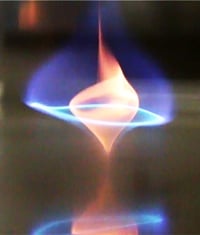 The yellow color is due to radiating soot particles. Blue in the whirl indicates there is enough oxygen for complete combustion, which means less or no soot and a cleaner burn. Image credit: A. James Clark School of Engineering."Blue whirls evolve from traditional yellow fire whirls," says Elaine Oran, professor of engineering and co-author of the paper. "The yellow color is due to radiating soot particles, which form when there is not enough oxygen to burn the fuel completely.” Blue in the whirl indicates there is enough oxygen for complete combustion, which means less or no soot.
Some oil spill remediation techniques include corralling the crude oil to create a thick layer on the water surface that can be burned in place. The resulting combustion often is smoky, inefficient and incomplete. However, the researchers say blue whirls could improve remediation-by-combustion approaches by burning the oil layer with increased efficiency, and reducing emissions into the atmosphere and the ocean.
"Fire whirls are more efficient than other forms of combustion because they produce drastically increased heating to the surface of fuels, allowing them to burn faster and more completely," says Michael Gollner, assistant professor of fire protection engineering and co-author of the paper. "In our experiments over water, we've seen how the circulation fire whirls generate also helps to pull in fuels. If we can achieve a state akin to the blue whirl at larger scale, we can further reduce airborne emissions for a much cleaner means of spill cleanup."
As there are currently few easy methods to generate a stable vortex in the lab, the team hopes their discovery of the "blue whirl" can serve as a research platform for the future study of vortices and vortex breakdown in fluid mechanics.



