Battery Self-Destructs after Powering Transient Electronics
Engineering360 News Desk | August 15, 2016The field of transient electronics produces devices with limited service lives. The electronics degrade or dissolve on exposure to heat, light, or moisture after a specified operating period. This self-destructive property could negate the need to retrieve environmental sensors from the field, or to explant medical devices from patients, or to dispose of or recycle electronic components.
Iowa State University researchers report development of a self-destructing, lithium-ion battery capable of delivering 2.5 V and dissolving or dissipating in 30 minutes when dropped in water. The battery can power a desktop calculator for about 15 minutes. Assistant professor of mechanical engineering Reza Montazami says it’s the first transient battery to demonstrate the power, stability, and shelf life for practical use.
The transient battery is composed of eight layers, including an anode, a cathode, and the electrolyte separator, all sandwiched between two layers of a polyvinyl alcohol-based polymer.
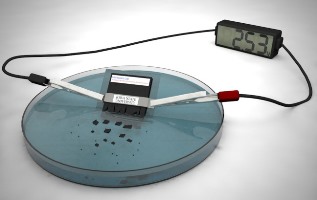 This working battery dissolves and disperses in water. Image source: Ashley Christopherson.The device is 1 millimeter thick, 5 millimeters long, and 6 millimeters wide. Montazami says the battery components, structure, and electrochemical reactions are all very close to commercially developed battery technology.
When dropped in water, the polymer casing swells, breaks apart the electrodes, and dissolves electrodes and dissolves. The battery doesn’t completely disappear. Instead, it contains nanoparticles that don’t degrade, but they do disperse as the battery’s casing breaks the electrodes apart.
For applications that require a longer-lasting charge, larger batteries with higher capacities could provide more power, but they also take longer to self-destruct. Those applications requiring higher power levels could be connected to several smaller batteries.
Even though batteries are tried-and-tested technology, Montazami says the transient battery project presented three major challenges for his research group.
First, he says the battery had to produce voltage similar to commercial batteries because many devices won’t operate if voltage is low or unsteady. Second, the batteries require multiple layers and a complex structure. And third, fabricating the batteries was difficult and took repeated attempts.