Marcellus Fracking Waste Below Federal Guidelines
John Simpson | August 12, 2016Drilling wastes produced at test fracking wells in the Marcellus shale formation are well below U.S. federal guidelines for radioactive or hazardous waste and thus safe to be transported on public roads to local landfills, West Virginia University (WVU) researchers have found.
“Radium is the dominant radioactive element in drilling wastes," notes Paul Ziemkiewicz, director of the West Virginia Water Research Institute at WVU. "In our study, the highest radium readings were below 10.8 pCi/g in the horizontal legs of the two production wells. The highest radium level in produced water found so far was 17 pCi/g. [These] are well below the U.S. Department of Transportation standard.”
Placing these materials in landfills, however, requires compliance with state landfill regulations, which are based on exposure levels, the researchers note.
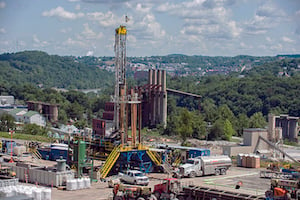 Top-hole drilling operation at a production well. Image credit: MSEEL.The MSEEL project site consists of an intensively instrumented science well and two shale gas production wells where university and federal researchers are studying what happens during and after hydraulic fracturing. The five-year project includes monitoring of baseline air, noise, light and water, as well as collection of geological, environmental and other data.
Ziemkiewicz and his research team are focusing on the solid and liquid drilling wastes that are generated during shale gas development, including drill cuttings, muds and produced water. Drilling a horizontal well in the Marcellus shale produces about 500 tons of rock fragments, known as cuttings.
The scientists found that using the “green” drilling mud BioBase 365 at the well site resulted in all 12 of their cuttings samples passing the U.S. Environmental Protection Agency’s test for leaching toxicity, allowing them to be classified as non-hazardous for non-radiological parameters such as benzene and arsenic. They determined that the drilling mud exerts a strong influence over the environmental risks associated with handling and disposal of drill cuttings.
Ziemkiewicz’s team also sampled the waste streams at the two production wells to identify changes in organic, inorganic and radiochemical composition over time. Among these findings, Ziemkiewicz notes that almost all contaminants increase through the production phase of an unconventional gas well as the volume of water drops (from about 50 gallons of produced water each minute per well initially to one-third of a gallon per minute currently).
While toxic concentrations far exceed permissible levels for drinking water or discharge to streams, most of this water is used for subsequent hydraulic fracturing operations. The remainder is disposed of under West Virginia underground injection well programs.