Moisture Boosts Perovskite Solar Cells' Efficiency
John Simpson | August 06, 2016Scientists at Okinawa Institute of Science and Technology (OIST) have determined why perovskite solar cells—which boast efficiencies of over 22%—benefit by their exposure to ambient air after fabrication: moisture in the air increases their efficiency. The finding could help to further improve perovskite solar cells’ performance.
“It’s intriguing: why do we need ambient air to enhance the effectiveness of perovskite solar cells?” says Zafer Hawash, an OIST PhD student who led the research. “Which component of the ambient air is linked to this phenomenon?”
Starting from these questions, he and fellow researchers focused on the top layer of the solar cells. The choice was logical, because even if a perovskite solar cell contains several layers—all of which may play a role in the cell efficiency—the top-most layer is the one in direct contact with the ambient air. Thus, that is the layer most likely affected by the external environment.
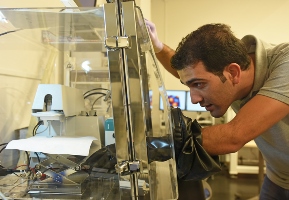 OIST student Zafer Hawash sets up a hanging mercury drop electrode system for conductivity measurement. Image credit: OIST.The layer is called the "hole transport layer" and it has a dopant, a substance that enhances the electrical conductivity of the material. “It is known that the dopant of the hole transport layer plays a key role in perovskite solar cells’ performance,” Hawash says. “But it was not clear how.”
The scientists performed controlled exposure of the hole transport layer to environmental gases, focusing on oxygen, nitrogen and moisture—water that is in a gas state. Then, they checked the electrical properties of the hole transport layer using a variety of methods to see if and how the inside of the transport layer changed.
“What we found is that oxygen and nitrogen do not have any role in the redistribution of the dopants,” Hawash says. “Moisture is the air component that causes the redistribution of the dopant across the material, and thus the enhancement of the electric properties of the solar cells.”
The scientists say this phenomenon has to do with the structure of the transport layer, which has many pinholes that allow the passage of gases between the ambient air and the underneath material. The dopant in the transport layer is a salt, lithium TFSI, which absorbs water. When the solar cells are exposed to moisture, the water absorbed by the transport layer causes the dopant to redistribute.
During their experiments, the researchers were also able to document the role of oxygen in the solar cells’ performance. “Oxygen enhances the electrical conductivity of the transport layer as well, but this effect does not last long,” Hawash says. “But with the right amount of exposure to moisture, the electric proprieties are irreversibly enhanced.”