Biofilm Protects Mortar Against Damaging Moisture
John Simpson | August 06, 2016A team of scientists at the Technical University of Munich (TUM) has found a way to protect mortar from damaging moisture by adding a biofilm produced by the bacterium Bacillus subtilis when the material is being mixed.
“Bacillus subtilis normally lives in soil and is a very common microorganism,” says Oliver Lieleg, professor of biomechanics at the TUM Institute of Medical Engineering. “For our experiments, we used a simple laboratory strain that grows rapidly, forms plenty of biomass and is completely harmless.”
Lieleg’s team bred the bacterial film on standard culture media in the lab. They then added the moist biofilm to the mortar powder and found that water was significantly less able to wet the surface compared to untreated mortar.
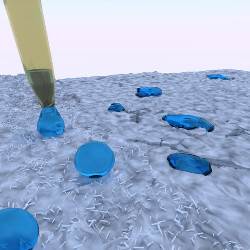 The surface of the hybrid mortar is covered with tiny crystalline spikes, resulting in the so-called lotus effect. Image credit: Stefan Grumbein/TUM). To evaluate this surface property, the scientists measured the contact angle between water droplets and the surface. The steeper this angle, the more spherical the drops are and the less likely the liquid is to soak into the material.
While the contact angle is typically 30 degrees or less on untreated mortar, it is three times as high for drops on the hybrid mortar. Water droplets on polytetrafluoroethylene, better known by the trade name “Teflon,” have a similarly high contact angle.
The hybrid mortar is currently undergoing mechanical tests to determine if it is durable enough to actually be used in construction applications.
“If the mortar is in fact suitable, there should be no problem for companies to produce it on a large scale,” Lieleg says, noting that both the bacterial strain used and the culture media are standard and relatively inexpensive. “We‘ve also discovered in our experiments that freeze-dried biofilm can be used equally well. Then, in a powder form, the biological material can be stored, transported and added much more easily.”
Future research will investigate whether the biofilm can also be used to protect concrete against water.