Tool Transforms Flat Materials Into 3D Shapes
John Simpson | August 01, 2016A computational design tool can turn a flat sheet of plastic or metal into a 3D shape, such as a mask, sculpture or shoe.
Researchers at Carnegie Mellon University in Pennsylvania and the École Polytechnique Fédérale de Lausanne (EPFL) say the tool enables designers to exploit the ability of certain materials to expand uniformly in two dimensions. A rubber band, by contrast, contracts in one dimension while it is stretched in another.
“We’re taking a flat piece of material and giving it the tendency, or even the desire, to bend into a certain 3D shape,” says Keenan Crane, assistant professor of computer science and robotics at Carnegie Mellon.
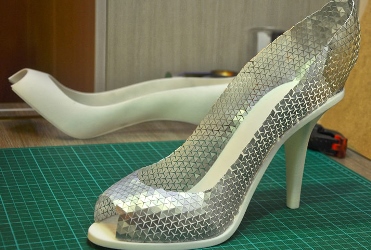 Researchers used a computational design tool to make a shoe whose base was 3D printed while the upper part was made from auxetic material. Image credit: CMU.The researchers made hexagonal cuts into flexible but not normally stretchable plastic and metal sheets to give them the ability to expand uniformly. The slits were cut into the sheets to create triangular elements that were able to rotate relative to their neighbors. This allows them to expand uniformly.
Based on a 3D digital model, the computational tool can determine the pattern of slits necessary to make the sheet conform to the desired shape. This pattern can then be transferred to a laser cutter to begin the fabrication process. The researchers used this process to make a high-heel shoe, a sculpture, an article of clothing, a lampshade and face masks.
But the design tool could also be useful for a variety of synthetic materials, known as auxetic materials, that have the capability to expand uniformly. Origami-style folding techniques have helped produce devices such as cardiac stents, which must be maneuvered into a heart patient’s artery and then expanded to hold the artery open, and solar arrays that unfold after being launched into space.
Auxetic materials could be used in similar ways. For instance, although bendable sheets can form single-curved surfaces such as cylinders, auxetic materials also can approximate double-curved surfaces, such as spheres, using only flat pieces.
The ability to design complex objects from auxetic materials could have a wide variety of applications in biomechanics, consumer goods and architecture, the researchers say.