Technique Advances Heat-to-Electricity Applications
John Simpson | July 27, 2016A University of California, Irvine (UCI) engineer has invented a method for analyzing nanowires at temperatures approaching 800 degrees Fahrenheit, that may help demonstrate the role the materials could play in converting excess heat from machines and electronics into useable electricity.
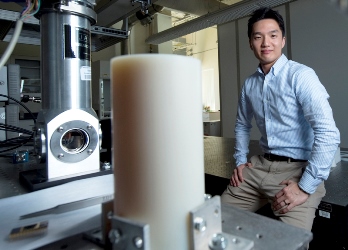 Jaeho Lee's nanomaterials lab features a customized vacuum chamber that allows investigation of substances' thermoelectric properties at extremely high temperatures. Image credit: Steve Zylius/UCI.“Auto manufacturers and tech startups are trying to utilize and commercialize heat-to-electricity applications, but first they need highly efficient building blocks to make that happen,” says Jaeho Lee, assistant professor of mechanical and aerospace engineering. “Our work verifies that certain materials would have good thermoelectric properties at the nanometer scale even at high temperatures.”
He and his colleagues customized a commercially available vacuum chamber and related equipment.
The apparatus could melt wire coatings and destroy the adhesives used to fuse nanowire chips to their holders. But the team alleviated these problems by using heat-tolerant wiring and screws instead of glues to hold pieces in place. They also created a sample-mounting platform that minimizes heat loss and lets researchers control the nanowires’ temperature with precision.
One fundamental goal of Lee's research is decoupling electrical conductivity and temperature to produce energy from waste heat. His work at UCI is demonstrating that silicon nanowires may be the right materials for the job. The findings of the study, conducted when Lee was a postdoctoral scholar at Lawrence Berkeley National Laboratory, also pave the way for other extreme-heat experiments, according to UCI materials scientist Allon Hochbaum, who was not involved in the research.
In their quest to recycle waste heat, engineers are seeking elements that permit the smooth flow of electricity while resisting heat. In bulk, silicon is a good transmitter of both electricity and warmth. But scientists have long witnessed a decrease in thermal conductivity when dealing with silicon at the micro- and nanometer scales.