Algorithm Helps Compute Groundwater Levels from Satellite Data
John Simpson | June 24, 2016A new computer algorithm developed at Stanford University is enabling scientists to use satellite data to determine groundwater levels across larger areas than ever before.
“It could be especially useful in agricultural regions where groundwater pumping is common and aquifer depletion is a concern,” says Rosemary Knight, professor of geophysics and co-author of a study reporting the results.
Knight and her colleagues recently applied the algorithm to determine groundwater levels across the entire agricultural basin of Colorado’s San Luis Valley. As a starting point, the algorithm uses data acquired using a satellite technology called Interferometric Synthetic Aperture Radar, or InSAR, to calculate changing groundwater levels in the valley between 1992 and 2000.
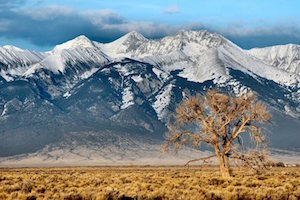 The algorithm was used to determine groundwater levels across the agricultural basin of Colorado's San Luis Valley. Image credit: National Weather Service. InSAR satellites use electromagnetic waves to monitor centimeter-scale changes in the elevation of the Earth’s surface. The program was initially developed in the 1980s by NASA to collect data on volcanoes, earthquakes and landslides, but Knight and colleague Howard Zebker, professor of geophysics and electrical engineering, in recent years have adapted the technology for groundwater monitoring.
Stanford scientists led by former postdoctoral scholar Jessica Reeves had previously shown that changes in surface elevation could be correlated with fluctuations in groundwater levels. However, they were able to do so for only a relatively small area because of the need to manually identify and analyze high-quality pixels in InSAR satellite images not covered by crops or other surface features that could obscure elevation measurements.
The new algorithm, developed by Jingyi “Ann” Chen, a postdoctoral researcher in Knight’s group, automates this previously time-consuming pixel selection process. “What we’ve demonstrated in this new study is a methodology that allows us to find high-quality InSAR pixels in many more locations throughout the San Luis Valley,” says Chen, who is first author of the new study.
Chen’s algorithm goes a step further by filling in, or interpolating, groundwater levels in the spaces between pixels where high-quality InSAR data are not available. Interpolation is a form of averaging, but it requires high-quality InSAR data from places that are located near monitoring wells where groundwater levels are already known in order to calibrate the link between the InSAR data and groundwater levels. In the previous work led by Reeves, only three monitoring wells were “co-located” with high-quality InSAR pixels. Using the new algorithm, that number increased to 16.
As a result, the team was able to calculate surface deformations—and by extension groundwater levels—for the entire agricultural basin of the San Luis Valley, an area covering about 4,000 square kilometers, or roughly five times greater than the area for which groundwater levels were calculated in the prior study. What’s more, team members were able to show how groundwater levels in the basin changed over time from 2007 to 2011—the years when InSAR data that could be analyzed by the algorithm were available.
Having a continuous map of deformation in the San Luis Valley led to the team discovering that there is a delay between the time when groundwater is pumped out of an aquifer and when the ground sinks, or subsides, in response to the water removal. These time lags might be useful indicators of the geological properties of an aquifer, says Knight.
"In a sand aquifer, there is no time lag between when the water is pumped out and the ground surface deforms,” Knight says. “However, if clay is present, it will take much longer to deform in response to pumping, so there will be a detectable time lag.”
The next step, Zebker says, is to take the information about groundwater levels and aquifer characteristics extracted from InSAR satellites and incorporate it with data from other sources to develop improved models of groundwater flow.
“The goal is to take into account the full water budget,” Zebker says. “This means accounting for water recharge such as rainfall and for discharge sources such as evaporation and runoff.”