Fiber-Based Lasers Use Molecular Gases to Produce Light
John Simpson | June 21, 2016A newly developed class of lasers could help scientists measure distances to faraway targets, identify the presence of certain gases in the atmosphere and send images of the earth from space. The lasers are also portable, energy efficient, produce light at difficult-to-reach wavelengths and have the potential to scale to high-powered versions.
Invented by a team led by Brian Washburn and Kristan Corwin, both associate professors of physics at Kansas State University, the lasers are fiber based and use various molecular gases to produce light. They differ from traditional glass-tube lasers, which are large and bulky and have mirrors to reflect the light.
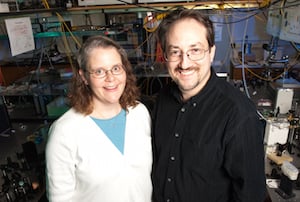 Kristan Corwin and Brian Washburn, associate professors of physics at Kansas State University, have invented a new patented class of lasers. Image credit: Kansas State University.The new technology uses a hollow fiber with a honeycomb structure filled with a molecular gas, such as hydrogen cyanide or acetylene. A second laser excites the gas and causes a molecule of the excited gas to spontaneously emit light. Other molecules in the gas quickly follow suit, which results in laser light.
"By putting the gas in a hollow core, we can have really high intensities of light without having to put such high amounts of power into the laser," Corwin says. "If you had a glass tube of that size and put light in it, the light would escape through the sides. It's actually the structure that makes it work."
The structure also allows for portability. In contrast to traditional lasers, which are fragile and cumbersome to move, the researchers' more durable fiber laser is about the thickness of a single strand of hair and can wrap around itself for compact storage and transportation.
The researchers are continuing to study and improve the lasers using fibers from the Xlim Research Institute, in Limoges, France, with funding from the U.S. Air Force Office of Scientific Research and the U.S. Air Force Research Laboratory.