Technology Helps Ease Oil Patch Pain
Bill Leventon | May 31, 2016Times have been tough for practitioners of hydraulic fracturing. The process, which uses water and some additives to crack open underground shale formations to tap oil and natural gas deposits, is in the crosshairs of activists concerned about its environmental impact. To make matters worse, fracking firms have recently seen their profits fall along with oil and gas prices.
But the news isn’t all bad for these firms, which are benefitting from some recent developments in fracking-related technology. While they may not end all of fracking’s woes, these technology developments are helping frackers address environmental concerns and still drill profitably despite low commodity prices.
Treatment in Texas
One location where new technology is coming to the aid is West Texas, where Apache Corp. uses what it describes as a “unique” system that allows the Houston-based oil and gas exploration and production firm to maintain a fracking operation without tapping freshwater supplies. Apache set up the system in its Barnhart location, an area of contiguous oil and gas fields, because the company believed it would pay for itself over the course of drilling many wells.
(Subscribe to the free Oil & Gas Technology newsletter from Engineering360.)
The system treats water from the Barnhart wells and supplements it with brackish water from a local aquifer that’s not fit either for human consumption or agriculture. In fracking operations, this mixture “is marginally more effective and certainly not any worse than freshwater,” says George King, distinguished engineering advisor at Apache. In addition, King says the cost of the recycled water is less than what Apache would pay for freshwater in the area.
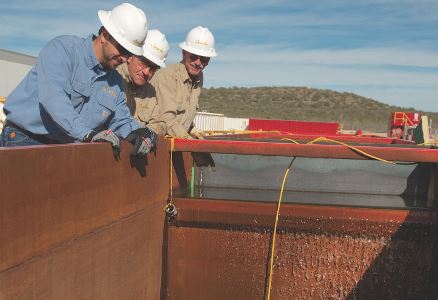 Workers watch Apache’s water recycling process in the Barnhart area of West Texas. Credit: Apache The system relies on a network of pipes running between well sites and the recycling facility, which is a centrally located collection of six double-lined grain bins equipped with leak-detection sensors. The first water that comes back from the wells—about 5% of the total—contains polymer that makes it difficult to recycle. After this water is discarded, the rest of the water is mixed with the brackish aquifer water, treated with chlorine dioxide and other chemicals used to process drinking water. In a final step, the water is piped back to the well sites for new fracking jobs.
Using this recycling system, Apache does not have to buy freshwater from municipal or commercial sources. “In the Barnhart area we have done all our fracking using this recycled salt water over and over again,” King says, adding that the resulting freshwater savings are “in the 200 million gallon range.” In addition, he says that the recycling operation has kept 80,000 or more truckloads of water off local roads.
Greener Fracking
In addition to water, hydraulic fracturing requires a proppant, a mixture that keeps hydraulic fractures open. In the past, proppants were sometimes laced with diesel and gasoline additives. These have now been banned, along with a number of other chemicals that were added to proppants in the early days to improve fracking results, says Chirag Rathi, principal energy and power systems consultant at Frost & Sullivan, a market research and analysis firm.
Nevertheless, proppant use still leaves toxic chemical residues in the ground. The good news is that there has been an ongoing effort to develop greener proppant materials. Rathi says that one result of this effort has been increased use of ceramics and composites in proppants. While these materials provide the mechanical strength to cause fractures, he says, these chemically inert materials do not harm the environment even if substantial quantities of them remain in the ground.
Additional work has focused on developing nanomaterials that can be combined with fracking fluids to boost oil flow out of rock. These chemicals were first introduced several years ago, King says, but they have now been developed to the point where frackers can show that small amounts boost oil recovery.
King describes the chemicals as surfactant blends that can either strip oil off rock or help recover it out of small pores. Apache has used some of these blends in its fracking operations, “and we’ve seen that they provide some good benefits,” he says.
Power from Gas
 Fracking can release quantities of natural gas, which is sometimes burned off at the well. Image source: Wikipedia Fracking can release quantities of natural gas, which is sometimes burned off at the well. Instead of “flaring” excess gas, Rathi says some frackers are using it to produce mechanical and electric power for their operations. Key to the switch from diesel fuel to natural gas is the development of natural gas engines with enough horsepower to replace diesel engines. Besides being more economical, Rathi says that natural gas is a cleaner fuel than diesel, potentially making the switch better for the environment.
Another development cited by King speeds up analysis of samples from underground to determine whether the location they came from is a good one for hydraulic fracturing. This analysis is aided by the appearance of suitcase-size mass spectrometers that can quickly measure the carbon chain length in samples to help exploration personnel identify areas with rich oil and gas deposits.
(Read “Gas-Fired Power Plants Are Being Sited Near Shale Plays.”)
Despite the potential benefits, Rathi says the oil and gas industry is “one of the last adopters of any new technology.” For example, he says that automation was late to come to drilling rigs. In recent years, however, he says energy companies have increasingly grown more serious about deploying programmable logical controllers, variable frequency drives, and other technologies that increase productivity by reducing the amount of manpower required to operate a rig.
Slow to Change
Why the reluctance among oil and gas firms to adopt potentially new and beneficial technologies? King, who evaluates 10 or more new technologies a month for Apache, says that “when profit margins are good and activity is at a frantic pace, nobody wants to rock the boat by using a new product.”
But during periods like the present one, barriers to entry fall as energy companies work to boost efficiency and cut costs. “It’s easier to get people to listen and try something new because, quite frankly, they are desperate,” King says, adding that new technology may also come at a lower price point because “our vendors are also feeling the crunch and want the business.”
Seen in that way, King says a bright side exists to the periodic busts in the oil and gas industry. “Price drops every once in a while actually help us get our act together by getting some new technology in and making us more efficient at what we do.”