Researchers Develop Low-Cost, Disposable Lasers
Riia O’Donnell | May 09, 2016A team of researchers from France and Hungary have printed lasers that may be so inexpensive and easy to produce, they could be disposed of after each use.
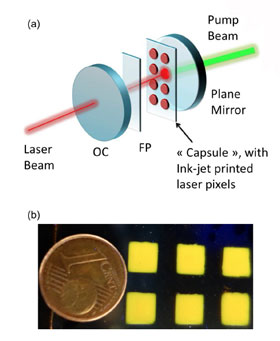 Lasing capsules, created with an inkjet printer. Image Credit: Sanaur, et al/JAP The lasers are efficient organic lasers that amplify light from materials that contain carbon. Not to be mistaken with inorganic lasers (those commonly found in DVD players, optical mice and laser pointers), these organics offer benefits that range from ease and low cost of fabrication to high-yield photonic conversion.
The team, representing Université Paris, Semilab and ENSM-SE, believes that although organic lasers degrade quickly, the fact that they are relatively inexpensive to produce means they could be discarded if they fail. The lasers work on a wide range of wavelengths and are produced with an inkjet process.
By using piezoelectric inkjet printing, the lasers are created at room temperature and are printed onto flexible materials. Because the inkjet process prints only the amount of ink required on the substrate, there is little if any waste in the process.
After testing a variety of inks, the team chose a commercial grade EMD6415, which they mixed with dyes. The ink was printed on a quartz slide in small squares. The dye became the “gain medium” or core of the laser. It amplified the light and produced the narrow laser beam.
While lasers require mirrors to reflect through the gain medium as well as an energy source to maintain amplification, the disposable part, the printed gain medium, is what was created. At an estimated cost of a few cents per piece, the printed gain medium could be the basis for an insert, similar to disposable razor blades, in a system that is easily switched when it fails.
Thus far, the researchers have been able to produce an emission from yellow to deep red, using two different dyes. They also expect to cover the blue and green spectrum.