A Faster Way to Fix Earthquake-Damaged Bridge Columns
Engineering360 News Desk | May 06, 2016A team of researchers from the University of Utah has developed a process for repairing earthquake-damaged bridge columns in as little as a few days.
In an earthquake, a bridge is designed to take the brunt of the damage at the top and bottom of the vertical columns where they meet the foundation and the horizontal beams. In instances when the columns can be repaired, engineers typically chip away at the concrete, replace any bent rebar and steel hoops inside and then pour new concrete into a steel cast that is built around the column. The process is a lengthy one that leaves the bridge unusable for weeks until the repair is finished.
A quicker and more cost-effective process, developed by a team led by Civil and Environmental Engineering Professor Chris Pantelides, involves creating concrete donuts known as “repairs” that are lined with a composite fiber material built around the top and bottom of each column. The material is a carbon fiber-reinforced polymer made of fibers and resin that is stronger than concrete and steel.
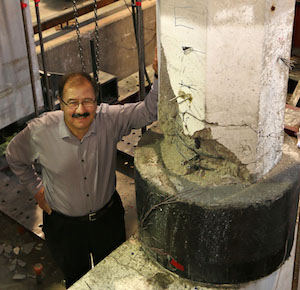 University of Utah Civil and Environmental Engineering Professor Chris Pantelides. Image credit: University of Utah College of Engineering/Dan Hixson.First, a number of steel rebars with heads are drilled into the foundation around the column and secured with an epoxy. Then, two halves of a circular shell made of the composite fiber (that are just millimeters thick) are placed around the column and rebar and spliced together. Concrete is poured around the column and over the rebar, with the composite fiber acting as a mold. The result is a repaired column with approximately the same structural integrity as the original column, Pantelides says.
“The circular shape gives you the best strength for the amount of material you are using. The stresses are distributed equally all around the periphery,” he says. “With this method, if there are future earthquakes or aftershocks, the bridge will survive and damage will happen adjacent to the donut. This gives the bridge a second life.”
The process could also be used to retrofit bridges to make them more earthquake-safe, though it was specifically designed for repair. Moreover, it is not limited to repairing bridges: the procedure can also be used on damaged columns around a building.
Pantelides and his team have filed patents on the process, which he says can be utilized by construction companies on earthquake-ravaged areas immediately.