Advancing Solar Cell Thermal Stability
Riia O’Donnell | May 02, 2016An international team from Brown University, the National Renewable Energy Laboratory (NREL) and the Chinese Academy of Sciences’ Qingdao Institute of Bioenergy and Bioprocess Technology has developed a method to convert perovskite, thin films of crystalline materials, enhancing its thermal stability and its capacity to absorb light.
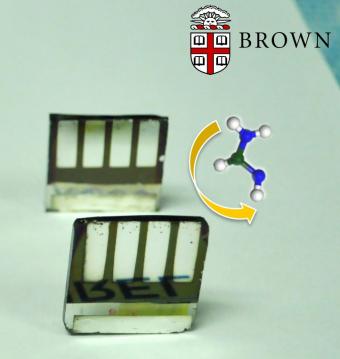 Brown University converts perovskite for enhanced pv capability. Image credit: Padture Lab / Brown University While perovskites are relatively inexpensive to produce, the findings may be a means to bring them even closer to the mass market. A relatively inexpensive and easy chemical conversion, their process allows cells to become more stable at moderate temperatures than what is currently available. The technique has the potential to be scalable, enhancing further the possibility of advancing research with the material.
Perovskites currently show promise in that they are competitive in the ability to convert light into energy with traditional cells. Less costly to produce, they can be created in a partially transparent form for applications in windows and skylights, as well as being used to boost the efficiency of silicon solar cells.
However, they are created with methylammonium lead triiodide (MAPbI3), which is degradable at the temperatures (around 185 F) that they are meant to be used. A way to overcome this issue would be to use formamidinium lead triiodide (FAPbI3), which shows higher thermal stability, but FAPbI3 cells are more complex to produce, even on a small scale.
By creating cells with MAPbI3 then exposing the thin films to formamidine gas at 150 C, the film converted from MAPbI3 to FAPbI3, yet retained the microstructure and morphology of the original. The gas removes the methylammonium from the crystal structure and replaces it with formamidinium. The team reported it was like “flipping a switch.” The technique is scalable, and the team reports efficiency of the cells at about 18%, approaching the target range of 20 to 25% of silicon cells.