Argonne Supercomputer Opens Up New World of Engine Design
Engineering360 News Desk | May 02, 2016A team of engineers at the Argonne National Laboratory's Virtual Engine Research Institute and Fuels Initiative (VERIFI) has completed development of engineering simulation code and workflows that will allow as many as 10,000 engine simulations to be conducted simultaneously on Argonne's supercomputer, Mira. This massive simulation capacity has opened up a new capability for industrial partners seeking new advanced engine designs.
Currently, engineers exploring new engine designs can perform a small number of simulations on cluster computers—perhaps 100—which can take weeks to complete. Each change of a variable in an engine design, such as piston bowl or fuel injector configuration, requires a new simulation—and changing multiple variables increases the number of required simulations exponentially—quickly using up the available computing power. At the end of this lengthy simulation process, the engineers have data to select promising designs to go to a prototype hardware build, but based on only a limited number of simulations with a limited number of variables.
"This new computing capability is a quantum leap from what anyone was doing before, and it holds the potential to unlock major breakthroughs in engine efficiency, as well as very substantial cost savings," says Sibendu Som, principal investigator and mechanical engineer at Argonne's Center for Transportation Research. "In the past, doing 10,000 simulations was unthinkable. Now we can do that in a matter of days."
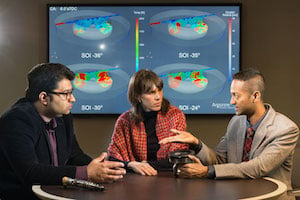 Argonne Mechanical Engineer Sibendu Som discusses piston bowl design with VERIFI team members Assistant Computational Scientist Marta García and Mechanical Engineer Janardhan Kodavasal. Image credit: ANL.While Mira is often used to do a few huge simulations, the VERIFI team wants it to handle large numbers of smaller, engineering-type simulations simultaneously. To get there, they had to optimize the source code of their engine simulation software and use an Argonne-developed, high-level programming language known as Swift to manage the massive workflows involved.
This massive simulation capacity has opened up a new capability for industrial partners seeking new advanced engine designs. VERIFI is already working with a major auto manufacturer, a leading company in energy and transportation and a global fuel supplier to put this new capability to work.
The researchers say that the power of supercomputing will not only increase the quality and quantity of simulations while reducing the development costs, it will also broaden the number of vehicle systems that can be simulated at once. The smaller computer systems VERIFI has been working with have forced engineers to focus on finite aspects of engine design, such as fuel injectors or the fluid dynamics of combustion. With this new approach, they can broaden their inquiry to the entire powertrain.
"The modern internal combustion engine is an extremely complex system, so it needs these types of computing resources to do simulations on the scale required to enable real breakthroughs," says Kevin Harms, senior software developer at Argonne. "This is a very exciting area of computer science that could have real-world impacts through greater transportation efficiency and a reduction in harmful emissions."