
Watch how efficiency, emission gains drive diesel engine simulations
S. Himmelstein | May 25, 2021Combustion chambers in heavy-duty diesel engines are being redesigned by U.S. Argonne National Laboratory (ANL) engineers to improve fuel efficiency and reduce emissions. Optimized piston bowl designs for Caterpillar Inc. engines have been identified in simulations performed with a 3D computational fluid dynamics tool.
Use of the CONVERGE software developed by Convergent Science Inc. reduced the simulation time from months to weeks and resulted in a piston bowl design configured to enhance the mixing process between fuel and air. The design could reduce fuel consumption by nearly 1% and slash soot emissions by up to 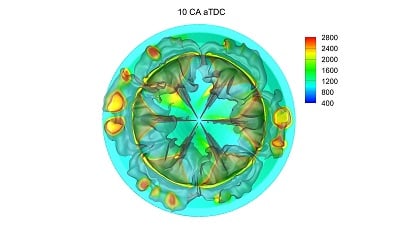 Supercomputers were used to optimize the design of piston bowls in heavy-duty engines for Caterpillar Inc. Source: Chao Xu/ANL20%.
Caterpillar has developed prototypes of the most promising designs with additive manufacturing technology to confirm simulation results. In addition to the project’s simulation innovations, one of the team’s key contributions was its development of an industry-friendly approach, which allows companies to optimize their engine designs using their own in-house computer systems, to enable engine design optimization by companies using their own in-house computer systems.
“The workflow we developed will benefit everyone,” said ANL researcher Sibendu Som. “We are publishing our methodology so companies can use it to design new piston bowls for themselves.”



My 1975 VW Rabbit had piston bowls. He head was basically flat with the valves tucked up in a trapezoidal cavity in the head along with the spark plug.
Guaranteed piston to valve clearance if you broke a timing belt. Even after I had the head shaved 40 thou. The dished pistons had a squish zone around the perimeter that forced the charge towards the center of the chamber as the piston neared TDC.
That little 1.5L liked to rev and had some nice scoot once I bumped up the compression. That in a car that barely weighed 1,500 pounds.