Consider Pressure Drop When Sizing Injection Pumps
Engineering360 News Desk | April 27, 2016Chemical injection pumps charged with injecting fluids into a pipe must be properly sized in order to overcome the pressure in the pipe, as well as the pressure drop in the chemical lines from the pump to the injection point. That means that a pump injecting into a pipe at 150 psi, for example, and which is located 250 ft. from the pump must overcome significant line losses. As explained in a post at the AquFlow website, the pump must deliver the required flow rate at well above 150 or even 200 psi.
(See the Engineering360 guide to injection pump suppliers and product catalogs.)
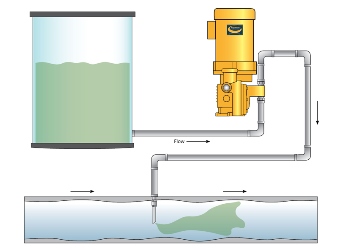 A chemical pump must be able to overcome the pressure in the pipe as well as the pressure drop in the lines from the pump to the injection point. Image source: AquaFlow.Pipe diameter also affects pressure drop: the smaller the pipe diameter the higher the drag and hence the pressure drop. AquaFlow advises be sure to follow the pump performance curve against overall pressure to ensure that flow requirements are met.
The article cites chemical-injection applications such as adding acid to water to achieve a certain pH balance or injecting a certain amount of disinfectant into water to a predetermined parts per million (PPM) and provides the formula for injection:
Injection Rate (IR), gal./hr. = 0.006 x Q x C / S
Where Q, system flow rate in gal/min.; C, desired PPM for the chemical; S, % concentration of the product/
With the rate of chemical injection known, you then can begin to size the pump, the company says.