Smart Sensor Predicts Failures in Car Tires and Hoses
Engineering360 News Desk | April 23, 2016A sensor that can help predict failures to the integrity of a tire, hose or other mechanical or medical equipment could help increase automotive safety, improve patient care and reduce liability costs.
The technology, developed by a Purdue University team led by Gary Krutz, professor of agricultural and biological engineering, uses a sensor that can predict, up to two weeks in advance, when a tire or hose is compromised and in danger of breaking. Detection of potential breakage in components such as O-rings and v-belts can help mitigate engine failures, the team says.
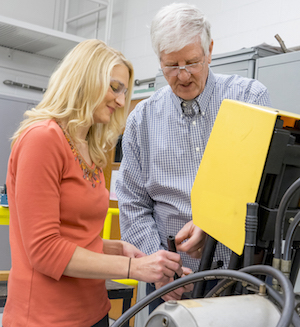 Brittany Newell, assistant professor of engineering technology, and Gary Krutz, professor of agricultural and biological engineering, examine hydraulic hoses used in mechanical machinery. Image credit: Purdue Research Foundation.Already, the technology has been licensed to Eaton Corp., a Cleveland-based power management company, for its LifeSense product, which monitors hydraulic hoses to identify hose wear and tear. When the sensor determines that the integrity of a hose has been compromised, a report is generated advising the user that a repair or replacement is required. That notification is provided with enough time to replace the hose during planned maintenance, saving downtime and clean-up costs, while avoiding environmental damage and potential injury.
"Besides natural wear and tear, tires, hoses and seals are subjected to harsh and unpredictable conditions, making them susceptible to damage that can cause vehicle road breakdowns and accidents, and the same concerns can be said for medical hoses like breathing hoses or tubes," Krutz says. "The relative cost to replace a hydraulic hose or tire before it breaks down is substantially less if it is replaced before it breaks down," he adds.
According to a National Highway Safety Traffic Administration (NHTSA) report, an estimated 414 fatalities, 10,275 non-fatal injuries and 78,392 vehicle crashes occurred annually due to flat tires or blowouts prior to a 2007 federal law requiring tire pressure monitoring systems to be installed in new vehicles. A separate NHTSA report states that 96.6% of vehicles involved in crashes have improperly inflated tires.
In addition to rubber products such as vehicle isolators, door and automotive seals and orthopedic devices, the sensor has been tested on over 100 other products, including shoes, airplane wing composites, boat hulls and sporting goods. "The potential uses of this technology touch nearly every industry," Krutz says.