Top 4 ways AI is influencing manufacturing
Kevin J. Harrigan | November 26, 2026Key takeaways
- Most engineers and OEMs remain in a phase of reluctance about AI, but machine designers and systems integrators are quickly figuring out when and how to use it, and they are seeing a return on that effort.
- Paired with vision technologies, AI models add flexibility to high-mix production lines and assembly-line inspection, and they minimize the need for engineers to stop lines for reprogramming or troubleshooting.
- AI must have consistent, reliable data and the trust of the humans around it, and that trust will build as humans get a chance to review the data.
There is a familiar pattern for AI adoption across many applications, not just industrial.
The first phase is novelty. Users are so wowed by its computation and ability to surface arcane ideas or data, they immediately start stress testing its limits.
That is typically followed by a period of reluctance, brought on by user concerns about the limits discovered. This can look like so many things: inaccuracies produced by the large language model (LLM), anxiety over data confidentiality, unease about what tasks should remain with humans, spiraling usage costs or potential new avenues for cyber risks.
Then there is the third phase. Here, users have found initial technical and moral boundaries with the AI models, know when and how to use them and have expedited workflows, sometimes, even nonstandardized ones, and are now seeing a return on that effort. This is the long-term payoff.
From a trending standpoint, many engineers and OEMs today remain in phase two. They are not willing to let their operations be the test bed for a new technology, no matter how transformative, that few understand and for which there are fewer regulations.
But machine designers and systems integrators are quicky figuring out phase three. Here are some key examples.
No. 1: AI’s influence on workpiece identification and processing
In many assembly situations, stationary workpieces are standardized and static — this makes it easy for a robotic arm to consistently and repeatedly install fasteners.
But in the era of contract manufacturing and high-mix production lines, workpieces are not always standardized. As a result, some manufacturers are looking to AI models, paired with vision technologies, to responsively identify assembly tasks, next steps and tooling targets on the workpiece.
This adds important flexibility for equipment on these types of lines and minimizes the need for engineers to stop lines for reprogramming or troubleshooting.
“I traditionally need an engineer that’s skilled not only at robot programming but also at vision systems and also at force control. Whereas in this world, once trained and originally configured, that AI model can take that place and I don’t have to have that highly skilled robot programmer every time there’s a change,” said Andrew Buckland, director of software and controls engineering at Fanuc.
No. 2: AI in manufacturing inspection and quality control
 In this demonstration, an AI vision system inspects and flags non-compliant specimens.
In another application that pairs AI with vision systems, deep learning models are interpreting product quality on the assembly line. Together they are a powerful way to identify production issues before they leave the factory and add responsiveness to production issues.
AI can be used for everything from inspecting product packaging to identifying material defects in automobiles to finding contaminants in food and beverage production. Electronics manufacturers are using this technique to identify assembly errors.
Notably, AI-driven inspection activities rely on a strong reference dataset for the AI to train on. This initial dataset can be difficult to obtain, especially for one-of-a-kind production steps or products. Slowly, vendors have found solutions in off-the-shelf datasets or data supplied in simulations. However, as the AI model gathers experience and human feedback, this inspection workflow becomes increasingly dependable.
No. 3: AI for operator and engineer interpretation and knowledge keeping
One common factory-floor bottleneck is equipment programming. Operators and coders are rarely one and the same. This creates challenges when equipment needs to be reprogrammed, which is often.
LLMs rely in part on natural language processing to confer with users. That lends itself to a variety of input formats — ranging from written language to spoken voice to gesture — that an AI interprets and turns into machine code.
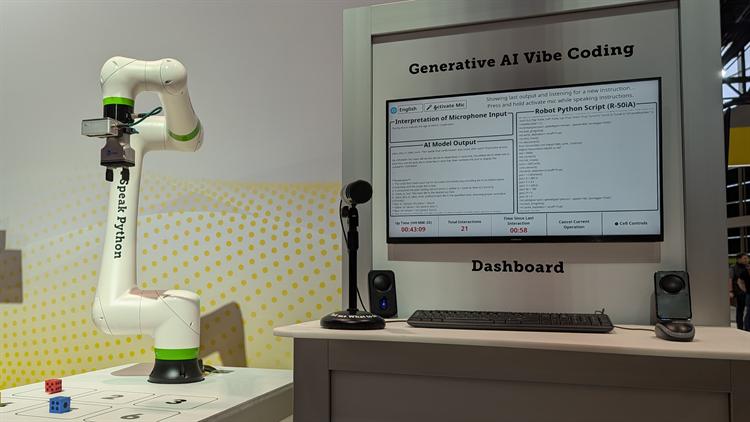 Users provide voice commands to the computer via the microphone, where an AI turns those into Python code to direct the six-axis arm.
“The AI model is interpreting the voice input and determining your intent... then it’s creating a series of commands that would need to happen to make that real. And then it compiles it all into a Python script that’s then handed over to the robot to execute,” said Buckland.
As engineers and factory workers retire, which they are doing in numbers faster than can be replaced, they are taking critical knowledge with them. By analyzing the data from success production runs, including equipment settings and instrument measurements, baseline operating procedures can be deduced —
and training materials are generated quickly.
No. 4: AI analysis for scaled sensor networks
By deploying sensor networks across a facility, be it on a storage rack or on a machine, AI models can help optimize on-hand resources.
On an individual level, health-monitoring sensors on machinery, such as temperature or vibration sensors, provide immense data for analysis to provide transparency about machine health. However, that data is often too much for a single individual to analyze quickly, let alone in real-time.
However, an AI that is actively monitoring equipment parameters will pick up on malfunctions quickly and may also be able to expedite a solution by alerting users and sourcing manuals, parts or service vendors.
There is nearly no end to the type of analysis AI can perform in manufacturing. However, two things must be true: it must have consistent, reliable data and it must have the trust of the humans around it.
That trust has proven elusive so far. As we’ve covered, AI excels at studying massive amounts of data, it does it much faster than humans.
As humans get a chance to review the data for AI in manufacturing, that trust will build, and more manufacturers will move into the payoff phase.