
Q&A: Severe duty vs explosion-proof — How to spec the right motor
Kevin J. Harrigan | October 27, 2026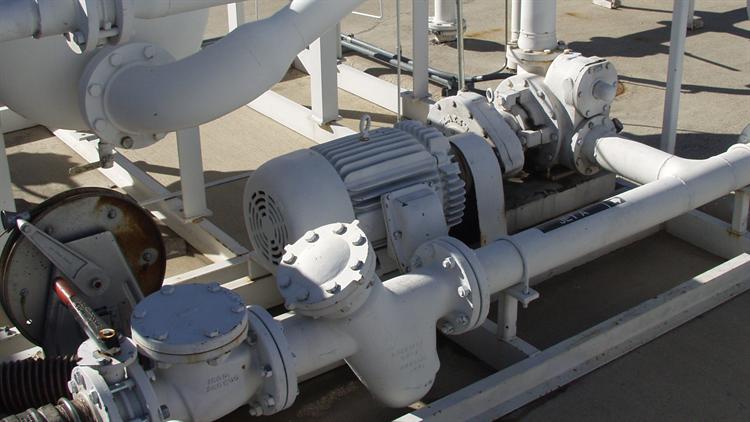 Explosion-proof motor solutions are built for durability and reliable performance in demanding fuel-handling environments where ignition protection is critical. Source: ABB
Key takeaways:
- A motor certified for a stricter hazardous-location rating can be used in a less stringent location, such as a Division 1 motor in a Division 2 area, but never the reverse.
- Explosion-proof motors must both contain an internal explosion and keep their surface temperature below the ignition point of the surrounding atmosphere.
Motors make the industrial world go round. So when they are required in challenging environments — such as in a sawdust-filled wood mill, below deck on a ship or driving the pump in a gas processing facility — the array of specifications, design features and standards can be extensive.
These types of applications require either a severe-duty motor or an explosion-proof motor, both of which are experiencing market growth due to increased demand in industries like energy and chemical processing, per Technavio, an industrial market research firm.
Although both are designed to handle the rigors of demanding use cases, these are not substitutes. Severe-duty motors often include many of the same design features as explosion-proof motors, yet the design and classification of explosion-proof motors are significantly more stringent.
 Oscar Palafox, global product portfolio manager, NEMA motors, ABBTo help delineate between the two, GlobalSpec recently interviewed Oscar Palafox, global product portfolio manager for ABB’s National Electrical Manufacturers Association (NEMA) motors, as well as Baldor-Reliance cast- iron motors. Palafox brings with him 25 years of experience in the industrial motor industry. He also contributes to industry standards development, including IEEE Std 841 and NEMA MG 1. Palafox is also vice chair of the Motor and Generator Section at NEMA.
Where does a severe-duty motor end and an explosion-proof motor begin?
Palafox: While both standard severe-duty and explosion-proof motors are built to withstand harsh environments, their applications differ significantly. Standard severe-duty motors are designed for hazardous areas where exposure to ignitable gas or dust is rare (Division 2), whereas explosion-proof motors are engineered for frequent or continuous exposure to these hazards (Division 1).
Can a motor be used in a location classified differently than what it is rated for?
Palafox: From a certification standpoint, a motor may be certified and used for higher requirements than the designated hazardous location demands, such as a Division 1 motor in a Division 2 location, but never the reverse. At minimum, the motor must meet the designated hazardous location's certification requirements. Hazardous location classifications are always provided by certification entities.
An explosion-proof motor has two jobs: contain an internal explosion and keep its external surface below the ignition temperature of the surrounding atmosphere. How do those two requirements shape its design?
Palafox: The design of an explosion-proof motor addresses two distinct challenges: internal explosion containment and maximum surface temperature. Enclosure robustness and fitment govern the mechanical side, while surface temperature is driven by winding temperature on the electrical side. Both must be carefully balanced to meet hazardous classification requirements without compromise.
How does designing a motor for combustible dust (Class II) differ from designing for flammable gas (Class I)?
Palafox: Contrary to general assumption, combustible dust environments (Class II) present greater design challenges than gas. Dust accumulation and confinement create two ignition risks, overheating and mechanical failure, both capable of triggering ignition.
Which applications or installation conditions present the highest risk for hazardous-location motors?
Palafox: More volatile gases and dust require lower temperature codes, narrowing design margins considerably. Constant-torque applications stress motors the most, and if a motor is undersized, the risk of overheating increases.
Variable frequency drives can induce shaft voltages that discharge across motor bearings. How is that risk addressed in a hazardous location?
Palafox: Spark risk, whether internal or external, is never taken lightly. Methods exist to ground induced shaft current and calculate the maximum discharge for specific motor designs, all of which must be validated by certification entities to ensure safety and asset protection.
What maintenance practices are different for an explosion-proof motor?
Palafox: Maintenance requirements for explosion-proof motors are standard, but thermal protection is critical. Failed control devices lead to overheating, which is an inconvenience in standard motors but a potential ignition hazard in explosion-proof applications.
Which industries and trends are driving demand for explosion-proof motors?
Palafox: Oil, gas and petrochemical industries remain the largest consumers of explosion-proof motors. While oil and gas growth has moderated from past decades, steady demand persists through conventional fuel consumption and emerging hydrogen applications. Meanwhile, food and beverage processing has emerged as the fastest-growing market for dust-area explosion-proof motors, reflecting broader industrial safety trends.


