Honda developing in-motion wireless EV charging system
Peter Brown | October 08, 2026 The vehicle assembly unit installed on an EV that will allow it to be charged while in motion. Source: Honda
Honda Motor Co.’s R&D subsidiary Honda R&D has developed a magnetic coupling wireless power transfer system targeted at enabling wireless in-motion charging of EVs.
The company, along with its partners Taisei Corp. and Taisei Rotec Corp., plans to conduct demonstration testing of the system in 2027.
The goal, the companies said, is to reduce the environmental impact of mobility products and services, including Honda’s goal to realize carbon neutrality by 2050.
How the in-motion charging system works
Each company contributed a piece of the system. Honda developed the power transmitter and receiver units, Taisei built the DC power supply that feeds them, and Taisei Rotec developed the methods for installing the equipment in the road surface.
These technologies allow high-power wireless power transfer (WPT) and ease of installation in road pavement. The companies said the system could be used for passenger EVs or large commercial transport fleets.
The in-motion charging system is part of a larger charging infrastructure project Honda is undertaking, including its Honda Charge, an EV charging network service in Japan. Honda has been working toward WPT technology since 2021.
What is in-motion charging?
Today, most EVs need to be charged either through a home charging system or a public fast-charging network found at retail locations or dedicated service stations globally.
WPT would allow EVs to be supplied power while they are in motion. This would reduce the frequency of charging needed from a public charging station or home charger.
In-motion charging systems consist of:
- A DC power supply system on the ground.
- A DC distribution-based ground assembly (GA) system that connects multiple GA units embedded in the road using a DC connection.
- A vehicle assembly unit installed on the vehicle.
As part of the Honda R&D efforts for the WPT road system, the system must feature GA units and pavement structures capable of withstanding large commercial vehicle traffic. The DC distribution structure must be highly efficient and deliver a stable power supply, the companies said. Additionally, the road and equipment infrastructure must be designed for easy installation and upgrading, they said.
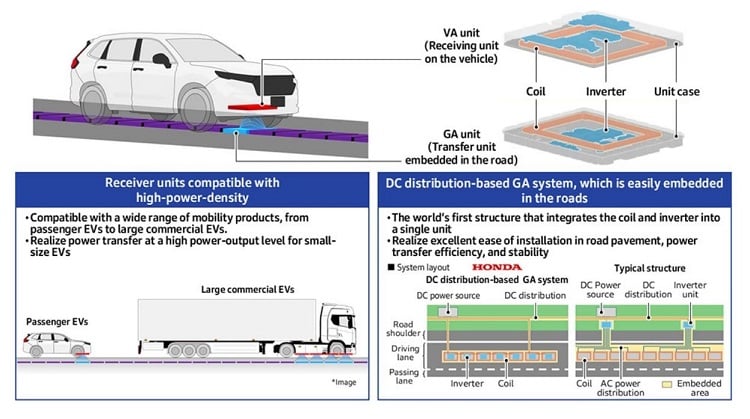 How the in-motion wireless charging system would work for both commercial fleet vehicles and passenger EVs. Source: Honda
First steps to in-motion charging
Honda said it will initially use WPT technology in logistics and transportation sectors.
By late 2026, the companies will build a test drive roadway at the Future Technology Field for Taisei Group/Tamura (T-FIELD/TAMRA). The companies will conduct various tests on this roadway, including:
- Long-term durability evaluation
- WPT performance tests
- Electromagnetic field leakage evaluations
These tests will seek to ensure both power transfer performance and the safety of the ground units embedded in the roadway.
During the next phase, the companies will look to real-world operation like verification of performance at high power output levels of up to 150 kW for commercial vehicles. This will also include verification of WPT performance for vehicles traveling at high speeds.
This will then lead to the demonstration on public roads sometime in 2027.