New hybrid magneto-rheometer advances smart fluid testing
GlobalSpec News Desk | October 05, 2026Researchers at the Indian Institute of Technology Patna have developed a hybrid magneto-rheometer designed to provide a more comprehensive way to characterize magnetorheological (MR) fluids under real-world operating conditions.
MR fluids are smart materials that rapidly increase in apparent viscosity when exposed to a magnetic field, allowing them to transition from a liquid-like state to a viscoelastic solid. Because their mechanical properties can be controlled using an electromagnet, MR fluids are used in adaptive technologies such as brakes, clutches, shock absorbers, dampers, vibration-control systems, actuators and medical devices.
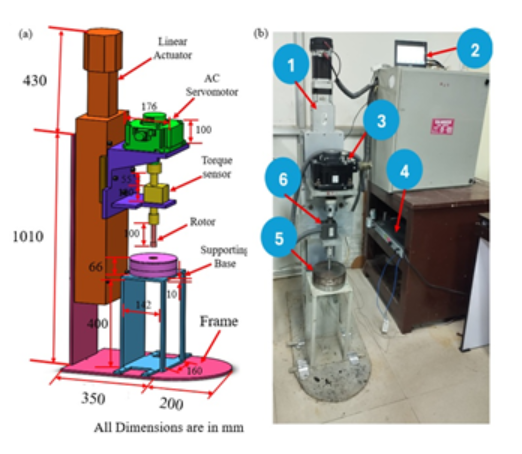 a). 3D CAD model of the test rig of the concentric cylinder magnetorheometer prototype, b). Experimental test setup for MR tribometer: 1: Linear actuator, 2: PLC Display, 3: AC servo-motor, 4: DC Power supply, 5: Magnetorheometer cell, and 6: Torque sensor. Source: the Indian Institute of Technology Patna
However, the behavior of MR fluids under combined compression and shear remains poorly understood, limiting their broader use. To address this challenge, the IIT Patna team developed nano-iron-powder-based MR fluids and a custom rheometer capable of simultaneously evaluating their rheological properties, including flow and deformation, and tribological properties, such as friction and wear.
Led by Professor Chiranjit Sarkar and supported by the Department of Science and Technology's Nano and Advanced Materials program, the team designed the device to test MR fluids under different normal loads, both with and without an applied magnetic field. The system generates a strong, uniform magnetic field across the sample while testing the fluid in a combined compression-and-shear mode.
The prototype provides a more detailed picture of MR fluid behavior than conventional characterization methods and could help researchers develop higher-performance materials for adaptive and energy-efficient technologies.
Beyond MR fluids, hybrid rheometers could also aid the study of viscoelastic materials used in industries ranging from polymers and pharmaceuticals to food processing, cosmetics and petrochemicals.